

Choosing the right educational support system is a critical decision for parents and students navigating the complexities of mathematics. Recent educational data shows that personalized instruction significantly accelerates learning curves compared to traditional classroom settings. According to a 2024 report on educational efficacy, students receiving individualized attention demonstrate a 40% higher retention rate of complex mathematical concepts. This statistic highlights why the debate between private and group instruction remains a primary concern for families seeking academic improvement. The following analysis breaks down the operational differences, cost structures, and pedagogical outcomes of both models to help you make an informed choice. (Home)
Understanding the Core Differences
Mathematics is a cumulative discipline. Each new concept builds directly upon previous knowledge, creating a steep learning curve for those who fall behind. Private tutoring and group classes address this challenge through fundamentally different mechanisms. Private tutoring focuses on hyper-personalized pacing, while group classes emphasize peer interaction and standardized progression. (Home)
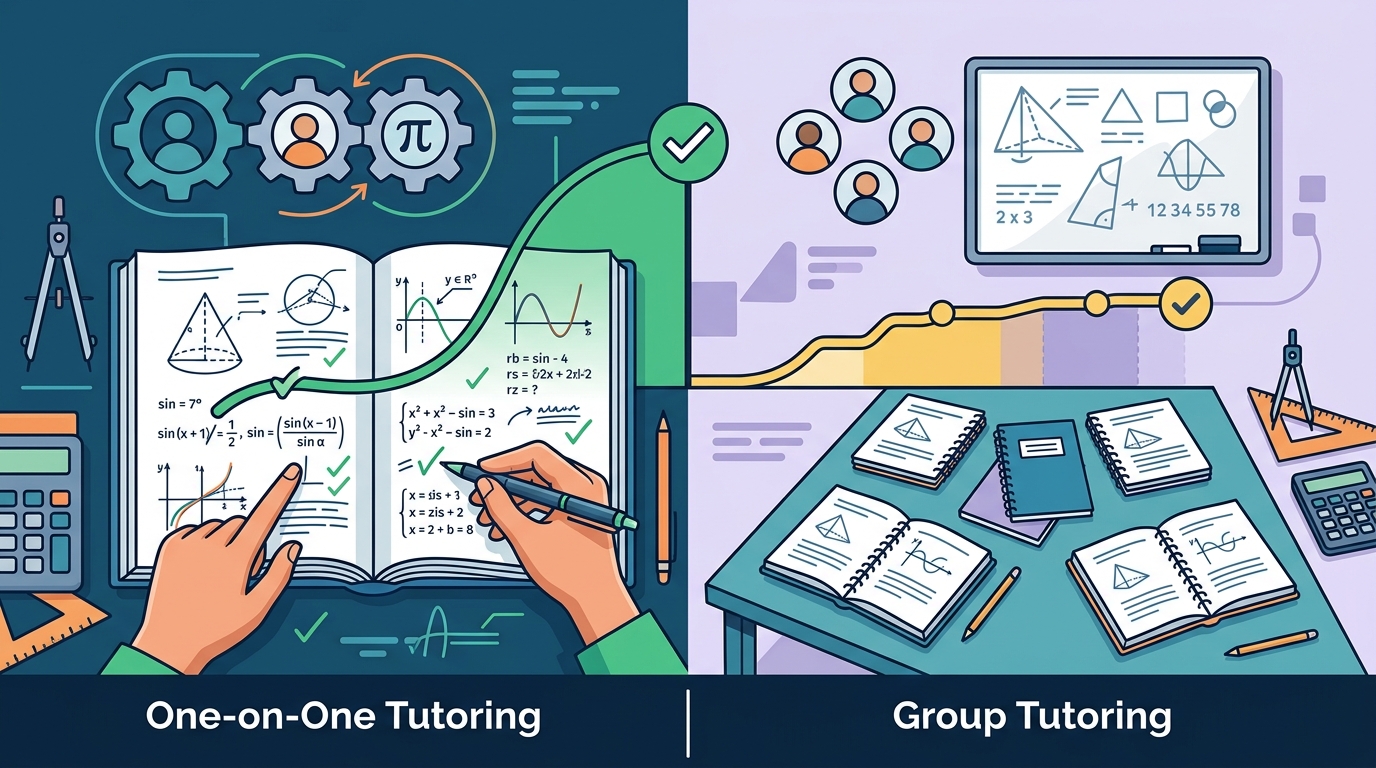
One-on-one tutoring is defined as a specialized educational service where a single instructor dedicates their full attention to one student. This model allows for immediate correction of misconceptions and tailored problem-solving strategies. In contrast, group math classes are defined as structured learning environments where one instructor teaches a small cohort of students simultaneously. This approach fosters collaborative learning but requires students to adapt to a fixed curriculum pace.
The choice between these models often depends on the student's current academic standing, learning style, and specific goals. Some students thrive in the competitive yet supportive atmosphere of a group. Others require the safe, judgment-free zone of private instruction to overcome math anxiety. Understanding the operational specifics of each is essential for long-term success.
Benefits of One-on-One Tutoring
Private tutoring offers unparalleled flexibility and depth of instruction. For students struggling with foundational gaps, this model is often the most effective intervention. The tutor can diagnose specific errors in real-time, addressing the root cause rather than just the symptom. This is particularly valuable for students with learning differences or those who need to accelerate their learning for advanced placement exams.
Adaptive Pacing
In a private setting, the curriculum is not bound by a syllabus. If a student masters algebra quickly, the tutor can immediately advance to calculus concepts. Conversely, if a student struggles with fractions, the tutor can spend weeks on that topic without holding back peers. This adaptive pacing ensures that the student is always challenged but never overwhelmed.
Building Confidence
Math anxiety is a significant barrier to academic success. Many students feel embarrassed to ask "basic" questions in front of classmates. Private tutoring eliminates this social pressure. Students are free to ask questions, make mistakes, and explore concepts without fear of judgment. This psychological safety is crucial for developing a growth mindset.
Personalized Strategies
Every student has a unique cognitive profile. Some learn visually, while others require kinesthetic or auditory approaches. A private tutor can identify these preferences and adapt their teaching methods accordingly. For example, a tutor might use physical manipulatives for a kinesthetic learner or visual graphs for a visual learner. This personalization leads to deeper conceptual understanding rather than rote memorization.
Advantages of Group Math Classes
Group math classes offer distinct benefits that private tutoring cannot replicate. The primary advantage is the opportunity for peer-to-peer learning. Students often explain concepts to each other in ways that are more relatable than teacher-led instruction. This collaborative environment also prepares students for the social dynamics of higher education and the workplace.
Collaborative Learning
Working in a group exposes students to multiple problem-solving approaches. When a student sees how a peer approaches a complex equation, they expand their own toolkit of strategies. This diversity of thought is invaluable for developing critical thinking skills. Group discussions also encourage students to articulate their reasoning, which reinforces their own understanding.
Cost Effectiveness
Financial constraints are a reality for many families. Group classes are significantly more affordable than private tutoring. By sharing the cost of instruction among several students, families can access high-quality education at a fraction of the price. This accessibility makes group tutoring a viable option for long-term academic support.
Social Interaction
For extroverted students, the social aspect of group classes is a major motivator. The camaraderie of working through difficult problems together can make math more enjoyable. Students often form study groups and continue learning outside of formal sessions. This sense of community can reduce isolation and increase engagement.
Cost and Logistics Comparison
The financial and logistical differences between private and group tutoring are substantial. These factors often play a decisive role in the final decision. Below is a comparative summary of the key operational metrics.
| Feature | One-on-One Tutoring | Group Math Classes |
|---|---|---|
| Cost per Hour | Higher (e.g., $100+/hr) | Lower (e.g., $20-$40/hr) |
| Pacing | Customized to student | Fixed by curriculum |
| Attention Level | 100% dedicated | Distributed among group |
| Flexibility | High (schedule/content) | Low (set times/topics) |
| Peer Interaction | Minimal | High |
Private tutoring typically commands a premium price due to the intensity of the service. For instance, experienced tutors with advanced degrees may charge rates reflecting their expertise and track record. Group classes, however, leverage economies of scale to offer lower rates. This makes them an attractive option for families seeking consistent, long-term support without the high financial burden of private sessions.
Choosing the Right Path for Your Student
There is no one-size-fits-all answer. The best choice depends on the student's immediate needs and long-term goals. Consider the following scenarios to guide your decision.
Choose One-on-One Tutoring If:
- The student has significant gaps in foundational knowledge.
- The student is preparing for a high-stakes exam (SAT, ACT, AP) in a short timeframe.
- The student experiences severe math anxiety or lacks confidence.
- The student is gifted and needs advanced material not available in school.
Choose Group Math Classes If:
- The student is generally keeping up but needs reinforcement.
- The student benefits from peer interaction and collaborative learning.
- The family is looking for a cost-effective, long-term solution.
- The student needs to develop study habits and organizational skills in a structured environment.
Many students benefit from a hybrid approach. They might attend group classes for regular reinforcement and supplement with private sessions for specific, difficult topics. This combination offers the best of both worlds: social engagement and personalized attention.
Key Takeaways
- Personalization: One-on-one tutoring offers 100% dedicated attention, allowing for customized pacing and immediate feedback.
- Cost: Group classes are significantly more affordable, making high-quality math support accessible to more families.
- Confidence: Private tutoring provides a safe environment to overcome math anxiety and build self-esteem.
- Collaboration: Group classes foster peer-to-peer learning and social skills essential for academic and professional success.
- Flexibility: Private tutors can adapt content to specific student needs, while group classes follow a fixed curriculum.
- Expertise: Experienced tutors, like those with 35+ years of classroom experience, can provide deep diagnostic insights.
- Hybrid Options: Combining both methods can maximize learning outcomes by addressing both academic and social needs.
Frequently Asked Questions
Is one-on-one tutoring worth the higher cost?
For students with specific learning gaps or high-stakes exam preparation, the accelerated progress often justifies the cost. The efficiency of personalized instruction can lead to faster grade improvements, potentially saving time and money in the long run.
Can group classes help with math anxiety?
Group classes can help some students by normalizing struggle and providing peer support. However, for students with severe anxiety, the pressure of a group setting may exacerbate their fears. In such cases, private tutoring is often a better starting point.
How do I know if my child needs private tutoring?
If your child is consistently struggling despite attending school and group classes, or if they have fallen behind significantly, private tutoring can help identify and fill specific knowledge gaps. A free consultation can help determine the best approach.
What is the typical rate for private math tutoring?
Rates vary based on the tutor's experience and qualifications. Experienced tutors with advanced degrees and extensive classroom history may charge premium rates, often around $100 per hour, though sliding scales may be available based on need.
Do group classes offer the same level of individual attention?
No, group classes distribute the instructor's attention among multiple students. While instructors strive to support everyone, the level of individualized feedback is inherently lower than in a one-on-one setting.
Can I switch from group classes to private tutoring?
Yes, many students transition between the two models based on their changing needs. You might start with group classes for general support and switch to private tutoring for specific exam prep or difficult topics.
What subjects are covered in private tutoring?
Private tutors typically cover a wide range of subjects, from basic arithmetic and algebra to advanced calculus and statistics. The specific subjects depend on the tutor's expertise and the student's needs.
Start Your Math Success Journey Today
Whether you choose the personalized focus of private tutoring or the collaborative environment of group classes, the most important step is taking action. Don't let math anxiety or academic gaps hold your student back. Contact Got Math Tutoring to schedule a free consultation and discover how we can help your student achieve their goals. Visit our Contact Page to get started.