

Parents and students often face a critical decision when seeking academic support: should they invest in traditional face-to-face sessions or embrace the flexibility of digital learning? The answer is not a simple binary choice but rather a nuanced evaluation of learning styles, logistical needs, and pedagogical outcomes. Recent educational data indicates that student performance is driven more by the quality of instruction and consistency of engagement than by the physical location of the tutor. According to a comprehensive review of modern tutoring efficacy, structured online interventions can yield results equivalent to in-person sessions when specific technological and pedagogical conditions are met. This article dissects the operational differences between these two models to help you make an informed decision for your academic journey. (Contact)
Understanding the Pedagogical Shift
The landscape of mathematics education has undergone a significant transformation over the last decade. Mathematical thinking is the process of analyzing problems logically and applying abstract concepts to find solutions. Historically, this was taught almost exclusively through chalkboards and physical textbooks. Today, the delivery mechanism has expanded to include sophisticated digital whiteboards, screen sharing, and real-time collaboration tools. This shift is not merely about convenience; it represents a fundamental change in how mathematical concepts are visualized and internalized.
For many students, the barrier to entry in mathematics is not a lack of intelligence but a lack of accessible support. The traditional model requires physical presence, which can be a significant hurdle for families in rural areas or those with busy schedules. Online tutoring removes these geographic barriers, allowing students to access specialized instruction that might otherwise be unavailable. However, the effectiveness of this model depends heavily on the tutor's ability to adapt their teaching style to a digital environment. (Home)
Understanding the pedagogical shift requires recognizing that mathematics is cumulative. Each new concept builds upon previous knowledge. Whether online or in-person, the tutor must identify gaps in this foundation. Research suggests that students who receive consistent, targeted intervention in either format show significant improvement in standardized test scores and classroom performance. The key lies in the consistency of the intervention and the rapport built between tutor and student. (Home)
The Advantages of Online Tutoring
Online tutoring offers a suite of advantages that align well with the demands of modern life. The most immediate benefit is flexibility. Students can schedule sessions that fit around extracurricular activities, sports, and other academic commitments without the stress of commuting. This flexibility reduces anxiety for many students who feel pressured by rigid school schedules. Furthermore, online platforms often provide recording capabilities, allowing students to review complex explanations at their own pace. This feature is particularly valuable for mastering difficult topics like calculus or algebra.
Another significant advantage is the use of interactive digital tools. Virtual whiteboards allow tutors to write, draw, and annotate in real-time, mimicking the classroom experience. These tools can include graphing calculators, geometry software, and dynamic equation solvers that make abstract concepts tangible. For example, visualizing a function's behavior through dynamic graphing can help students grasp limits and derivatives more intuitively than static textbook diagrams. According to educational technology studies, the use of dynamic visualization tools enhances conceptual understanding in mathematics by up to 20 percent compared to traditional methods alone.
Additionally, online tutoring fosters independence. Students learn to manage their own learning environment, organize their digital materials, and communicate effectively through technology. These are essential skills for higher education and the modern workforce. The digital interface also allows for easier integration of multimedia resources, such as video tutorials and interactive quizzes, which can reinforce learning outside of the session. This blended approach ensures that learning is continuous and engaging.
The Value of In-Person Interaction
Despite the rise of digital learning, in-person tutoring retains distinct advantages that cannot be fully replicated online. The primary benefit is the richness of non-verbal communication. A tutor can observe subtle cues in a student's body language, facial expressions, and posture to gauge understanding and frustration levels in real-time. This immediate feedback loop allows for instant adjustments in teaching strategy. For instance, if a student appears confused by a particular step in a proof, the tutor can physically point to the specific part of the equation or use physical manipulatives to clarify the concept.
In-person sessions also minimize distractions. While home environments can be comfortable, they are often filled with potential interruptions such as siblings, pets, or household noise. A dedicated tutoring space, whether at a library or a private home, provides a focused environment conducive to deep work. This is particularly important for students who struggle with attention or executive function. The physical presence of a mentor can also provide a sense of accountability and motivation that is harder to achieve through a screen.
Furthermore, in-person tutoring allows for the use of tactile learning aids. For younger students or those with specific learning differences, physical objects like blocks, counters, and geometric shapes can make abstract concepts concrete. The ability to physically manipulate these objects helps build a strong intuitive foundation for mathematical operations. This hands-on approach is often more effective for kinesthetic learners who struggle with purely visual or auditory instruction.
Comparing Learning Outcomes
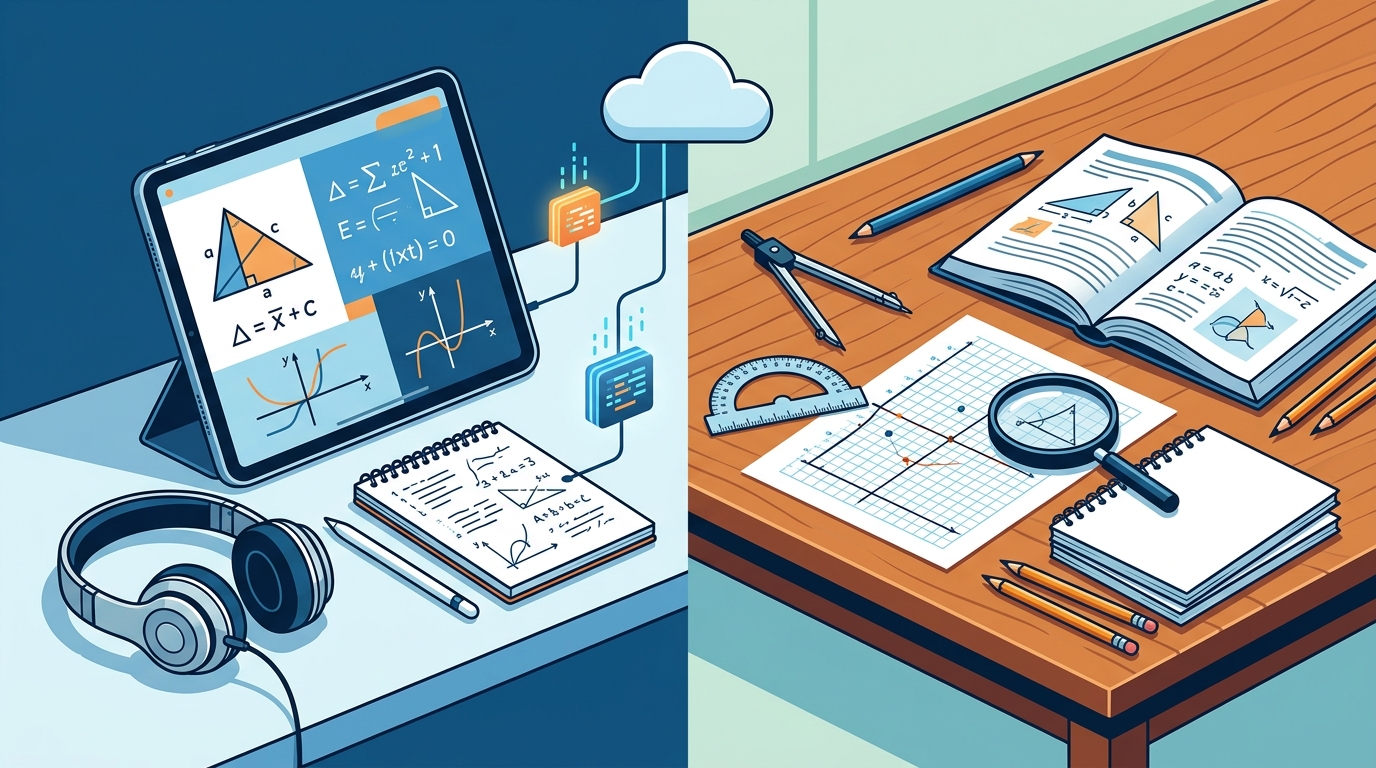
When comparing the effectiveness of online versus in-person tutoring, it is crucial to look at the data. Numerous studies have shown that both modalities can lead to significant academic improvement when delivered by qualified instructors. The critical factor is not the medium but the quality of the interaction. A highly engaged online session is far more effective than a passive in-person one. Conversely, a distracted online student will not benefit regardless of the technology used.
| Factor | Online Tutoring | In-Person Tutoring |
|---|---|---|
| Flexibility | High. Sessions can be scheduled from anywhere. | Low. Requires physical travel and fixed locations. |
| Distractions | Variable. Depends on home environment. | Low. Controlled environment minimizes interruptions. |
| Visual Tools | Dynamic. Interactive software and screen sharing. | Static. Physical whiteboards and manipulatives. |
| Non-Verbal Cues | Limited. Relies on camera quality and student engagement. | High. Full body language and facial expression visibility. |
| Cost | Often lower. No travel time or overhead costs. | Often higher. Includes travel time and space rental. |
Research indicates that student satisfaction is often higher in online settings due to the convenience factor. However, academic gains are comparable when the tutor is skilled in both modalities. The key is matching the student's learning style to the appropriate medium. Some students thrive in the digital space, while others need the physical presence of a mentor to stay focused. Understanding these nuances is essential for maximizing the effectiveness of tutoring.
Choosing the Right Model for Your Needs
Selecting the right tutoring model depends on several factors, including the student's age, learning style, and specific academic needs. For younger students, particularly those in elementary and middle school, in-person tutoring may be more effective due to the need for tactile learning and close supervision. These students often benefit from the physical presence of a mentor who can guide their hands and monitor their focus closely.
For high school and college students, online tutoring can be highly effective. These students are typically more self-directed and comfortable with technology. They can leverage digital tools to explore complex mathematical concepts independently. Additionally, the flexibility of online sessions allows them to balance tutoring with other academic and social commitments. However, students who struggle with self-discipline may still benefit from the structure of in-person sessions.
It is also important to consider the specific subject matter. For subjects like geometry, where visual spatial reasoning is key, both modalities can be effective. Online tools can provide dynamic visualizations, while in-person tools offer tactile exploration. For subjects like calculus or algebra, where abstract reasoning is paramount, the clarity of explanation is more important than the medium. A skilled tutor can deliver clear, precise explanations in either format.
Key Takeaways
- Effectiveness depends on tutor quality and student engagement, not just the delivery method.
- Online tutoring offers superior flexibility and access to interactive digital tools.
- In-person tutoring provides richer non-verbal communication and reduced distractions.
- Both modalities can lead to significant academic improvement when tailored to the student's needs.
- Digital tools enhance conceptual understanding through dynamic visualization.
- Tactile learning aids are crucial for younger students and kinesthetic learners.
- Consistency and rapport are the most critical factors in tutoring success.
Frequently Asked Questions
Is online math tutoring as effective as in-person?
Yes, online math tutoring can be just as effective as in-person sessions when the tutor is skilled in digital pedagogy and the student is engaged. The key is consistent interaction and the use of appropriate digital tools.
What age group benefits most from online tutoring?
Older students, particularly those in high school and college, often benefit most from online tutoring due to their comfort with technology and need for flexibility. However, younger students can also succeed with parental support.
How do I know if my child needs in-person tutoring?
If your child struggles with focus, needs tactile learning aids, or is in early elementary grades, in-person tutoring may be more beneficial. It provides the physical presence and structure they need.
Can online tutoring help with math anxiety?
Yes, online tutoring can help reduce math anxiety by providing a comfortable, low-pressure environment. Students can learn from home, which can feel safer than a classroom or tutoring center.
What technology is required for online tutoring?
A stable internet connection, a computer or tablet with a webcam and microphone, and a digital whiteboard application are typically required. Most platforms provide user-friendly tools that are easy to navigate.
How does online tutoring handle homework help?
Online tutors can review homework in real-time using screen sharing. Students can upload photos of their work, and the tutor can annotate directly on the screen to provide immediate feedback.
Is online tutoring more affordable?
Online tutoring is often more affordable because tutors do not incur travel costs or overhead expenses associated with physical spaces. This can result in lower rates for students.
Schedule Your Consultation
Choosing the right tutoring model is a significant step toward academic success. Whether you opt for the flexibility of online sessions or the focused environment of in-person tutoring, the goal is the same: to build confidence and mastery in mathematics. At Got Math Tutoring, we believe that every student is capable of learning mathematics. Our approach emphasizes understanding, not just procedures, and we are dedicated to helping students develop the critical thinking skills they need for success in life.
If you are ready to explore how we can support your academic journey, we invite you to schedule a free first consultation. This initial meeting will help us determine if we are a good fit and outline a personalized plan for your success. Contact us today to take the first step toward mathematical confidence.