

Choosing the right educational support system is often the most critical decision a parent or student makes when facing academic challenges. The debate between private instruction and classroom-based group learning is not merely about preference, but about cognitive alignment and learning velocity. Recent educational research indicates that while group settings foster social collaboration, individualized instruction accelerates mastery of complex mathematical concepts by addressing specific knowledge gaps immediately. Understanding the distinct advantages of each model allows families to make data-driven decisions that align with a student's unique psychological and academic needs. (Contact)
Core Differences in Instructional Delivery
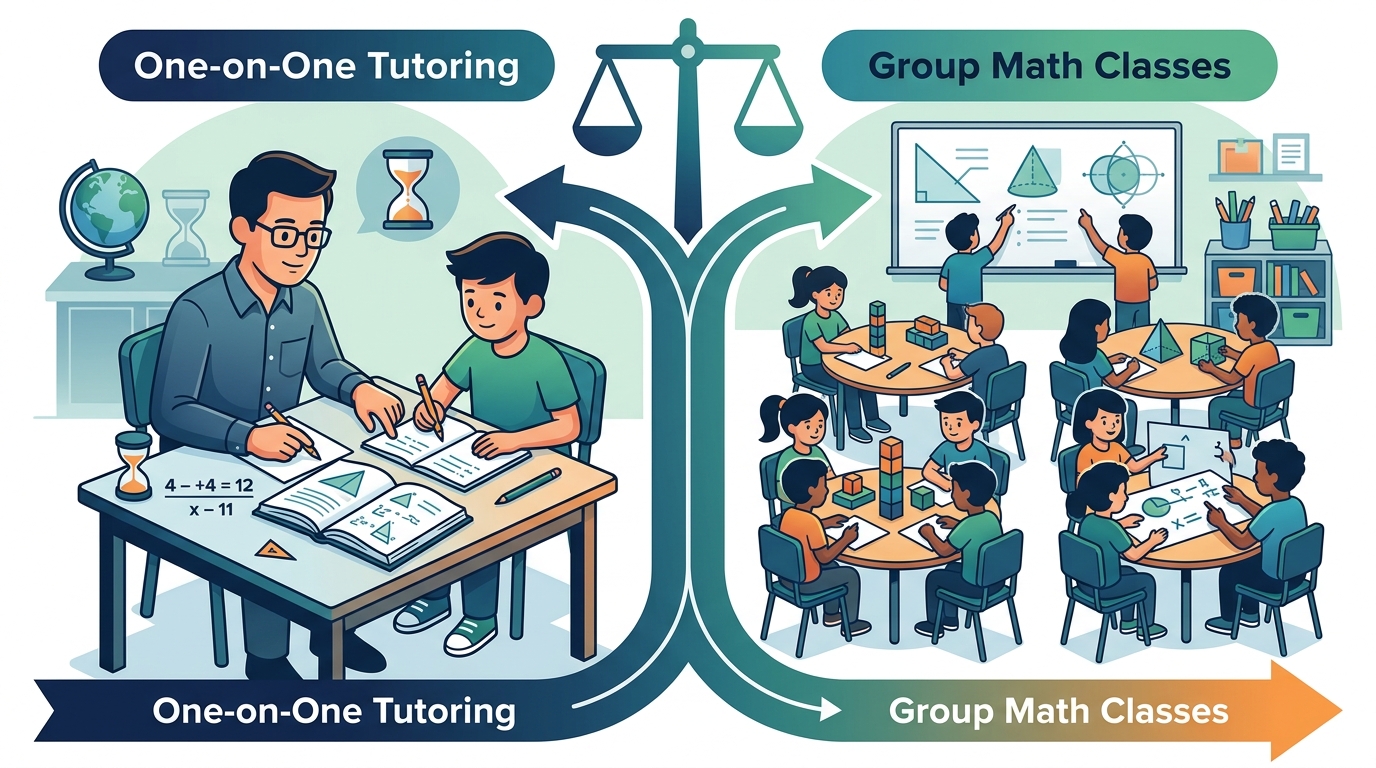
The fundamental distinction between these two models lies in the adaptability of the curriculum. In a group setting, the instructor must adhere to a standardized pace designed for the median student. This approach ensures that all participants receive the same foundational content, but it often leaves advanced students bored and struggling students behind. Conversely, private tutoring operates on a demand-driven model. The curriculum is dynamically adjusted in real-time based on the student's immediate comprehension levels.
Mathematical learning is both cumulative and cyclical. It builds like a tower, while also spiraling back to revisit and deepen earlier ideas. When a student misses a foundational concept in a large class, that gap widens with every subsequent lesson. Private instruction acts as a targeted intervention, closing these gaps before they become insurmountable obstacles. This method ensures that true understanding comes from mathematical thinking, not just completing procedures. (Home)
The Advantages of One-on-One Tutoring
One-on-one tutoring offers an unparalleled level of focus that is impossible to replicate in a crowded classroom. The tutor can dedicate 100% of their attention to the student's specific thought processes, identifying exactly where logical errors occur. This level of scrutiny allows for the immediate correction of misconceptions, preventing the reinforcement of incorrect methods. (Home)
For students who believe they "will never get math," this model is particularly transformative. The tutor helps them move gradually from a fixed mindset toward a growth mindset. Making mistakes is not only acceptable, it is essential. Mistakes help the brain grow. We now know that the brain is plastic, not static, and that ability and intelligence can develop with effort and practice. The idea that "neurons that fire together wire together" explains how new neural pathways are formed when students struggle productively and learn from errors. Real learning occurs at the point of challenge.
Furthermore, private sessions allow for the development of precise language skills. Precise language deepens mathematical understanding. In a group, students may hesitate to ask "basic" questions for fear of judgment. In a private setting, every question is validated, fostering an environment where curiosity thrives without social inhibition.
The Role of Group Learning Dynamics
While private tutoring offers speed and precision, group math classes provide unique social and collaborative benefits. Group learning forces students to articulate their reasoning to peers, which reinforces their own understanding. Explaining a concept to another person is one of the most effective ways to master it. This peer-to-peer interaction builds communication skills that are essential for future academic and professional success.
Group settings also expose students to multiple problem-solving strategies. In a private session, the student learns the tutor's preferred method. In a group, they see how different individuals approach the same equation. This diversity of thought can be incredibly liberating for students who feel stuck in a single way of thinking. It demonstrates that mathematics is not a rigid set of rules, but a flexible tool for logical analysis.
However, the effectiveness of group learning is heavily dependent on the group's composition and the instructor's ability to manage diverse needs. If the gap between the highest and lowest performers in the group is too wide, the median pace will inevitably fail one or both extremes. This is where the targeted approach of private instruction often proves superior for rapid academic recovery.
Managing Math Anxiety and Confidence
Math anxiety is a real obstacle for many students. It is not simply a lack of ability, but a psychological barrier that inhibits cognitive function during testing and problem-solving. For students with high anxiety, the pressure of a group environment can be paralyzing. The fear of being called on, or of being seen struggling, can trigger a stress response that blocks information processing.
Private tutoring provides a safe, low-stakes environment to dismantle this anxiety. The tutor works to build confidence incrementally, celebrating small victories and normalizing the struggle of learning. This supportive dynamic is crucial for students who have developed a negative self-image regarding their mathematical abilities. By meeting students where they are, the tutor helps them find their footing and confidence in math, and genuinely makes them feel available and interested in their success.
In contrast, group classes can sometimes exacerbate anxiety if the social dynamics are not carefully managed. However, for students who thrive on social motivation, the camaraderie of a group can be a powerful driver. They may push themselves harder because they do not want to fall behind their peers. Understanding the student's personality type is therefore critical in choosing the right format.
Cost, Accessibility, and Value Analysis
When evaluating these options, financial considerations are unavoidable. Private tutoring is typically priced on an hourly basis, reflecting the intensive, personalized nature of the service. For example, rates for specialized tutoring can range significantly based on the tutor's experience and credentials. At Got Math Tutoring, the rate is $100/hour, with a sliding scale available based on need and commitment. This model ensures that high-quality instruction remains accessible to families who might otherwise be priced out.
| Feature | One-on-One Tutoring | Group Math Classes |
|---|---|---|
| Pace | Customized to student speed | Standardized for the group |
| Attention | 100% dedicated focus | Distributed among multiple students |
| Cost | Higher hourly rate (e.g., $100/hr) | Lower per-student cost |
| Social Interaction | Minimal, focused on tutor-student | High, peer-to-peer collaboration |
| Best For | Specific gaps, anxiety, acceleration | Social learners, broad review |
While the upfront cost of private tutoring is higher, the return on investment can be substantial. Faster mastery of difficult topics means less time spent on homework, reduced need for summer remediation, and improved long-term academic performance. For students who are struggling significantly, the efficiency of private instruction often outweighs the initial financial outlay.
Key Takeaways
- Adaptability: One-on-one tutoring allows for real-time curriculum adjustments, whereas group classes follow a fixed pace.
- Math Anxiety: Private settings are superior for reducing anxiety by providing a safe, judgment-free zone for error correction.
- Neuroplasticity: Learning from mistakes is essential for brain growth, a process best supported in individualized feedback loops.
- Cost Structure: Private rates like those at Got Math Tutoring ($100/hour) offer a sliding scale to accommodate different financial needs.
- Experience: Tutors with 35+ years of classroom experience, such as Michael J. Murphy, bring deep pedagogical insight to private sessions.
- Outcomes: Former students of specialized tutoring often progress to careers in engineering, teaching, and Ivy League institutions.
- First Step: A free first consultation is available to determine the best fit for the student's specific learning style.
Frequently Asked Questions
Is one-on-one tutoring more effective than group classes?
For rapid improvement and addressing specific knowledge gaps, one-on-one tutoring is generally more effective due to its personalized pace and focused attention. Group classes are better for social learning and broad review.
How much does private math tutoring cost?
Pricing varies by tutor and location. At Got Math Tutoring, the standard rate is $100 per hour, but a sliding scale is available based on financial need and commitment level.
Can tutoring help with math anxiety?
Yes. Private tutoring provides a low-pressure environment where mistakes are normalized. This approach helps students shift from a fixed mindset to a growth mindset, significantly reducing anxiety.
What subjects do private tutors cover?
Private tutors typically cover a wide range of subjects from elementary arithmetic to advanced calculus. The specific subjects depend on the tutor's expertise, such as Michael J. Murphy's extensive background in mathematics.
Is online tutoring as effective as in-person?
Online tutoring can be just as effective, particularly for students who are comfortable with digital tools. It offers flexibility and convenience, allowing students to receive high-quality instruction from home.
How do I know if my child needs private tutoring?
If a student is consistently struggling with homework, showing signs of math anxiety, or falling behind the class pace, private tutoring can provide the targeted support needed to get back on track.
What is the first step to getting started?
The first step is to schedule a free consultation. This allows the tutor and family to discuss the student's needs, learning style, and goals to determine if they are a good fit.
Start Your Journey
Whether your child needs a confidence boost, a targeted intervention for a specific topic, or advanced enrichment, the right support can change their entire academic trajectory. Do not let math anxiety or knowledge gaps hold your student back. Contact Got Math Tutoring today to schedule your free first consultation and discover how personalized instruction can transform your child's relationship with mathematics.