

Math anxiety affects a significant portion of students, with data showing that approximately 60% of students experience some level of math-related stress. This anxiety often stems from a lack of immediate support when concepts become difficult. While traditional group classes provide a structured environment, they cannot always address the unique learning gaps of every individual. Understanding the differences between private instruction and classroom settings is essential for parents and students seeking academic improvement.
Core Differences in Learning Dynamics
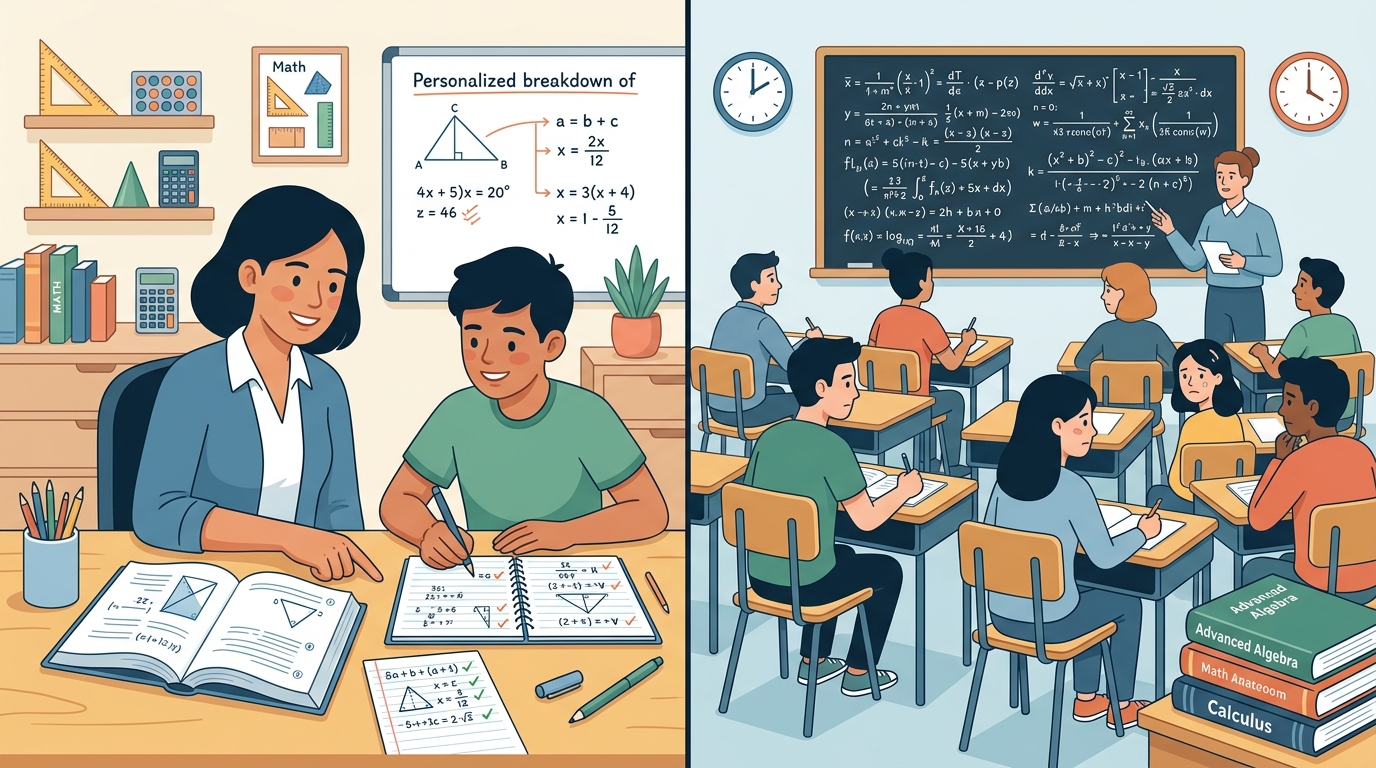
The fundamental difference between one-on-one tutoring and group math classes lies in the ratio of instruction to interaction. In a group setting, the teacher must cater to the average level of the class. This often means that advanced students may feel bored, while struggling students may fall further behind. Private tutoring eliminates this compromise by focusing entirely on the student's specific needs.
Math is a cumulative subject. If a student misses a foundational concept in algebra, they will likely struggle with calculus later. One-on-one tutoring allows the instructor to identify and repair these specific gaps immediately. According to educational research, targeted interventions yield faster results than general classroom remediation. This is because the feedback loop is immediate and direct.
Group classes offer social benefits. Students can learn from their peers and develop collaborative problem-solving skills. However, the primary goal of a classroom is often curriculum coverage, not individual mastery. Private tutoring prioritizes mastery over speed. This distinction is critical for students who need to build confidence before moving forward.
The Power of Personalized Attention
Personalized attention is the most significant advantage of private tutoring. In a one-on-one setting, the tutor can adapt their teaching style to match the student's learning preferences. Some students are visual learners who benefit from diagrams. Others are kinesthetic learners who need to manipulate physical objects to understand abstract concepts.
Michael J. Murphy, a master teacher with over 35 years of experience, emphasizes that true understanding comes from mathematical thinking, not just completing procedures. This approach is only possible when the instructor can focus on one student at a time. He helps students develop a growth mindset by reframing mistakes as essential parts of the learning process. This psychological shift is difficult to achieve in a crowded classroom where time is limited.
Private tutors also address the emotional barriers to learning. Math anxiety is a real obstacle for many students. A dedicated tutor creates a safe space where students feel comfortable asking questions without fear of judgment. This emotional support is often the key to unlocking a student's potential. It transforms the experience from one of dread to one of empowerment.
Pace and Flexibility Advantages
One of the most practical benefits of private tutoring is the ability to control the pace of learning. In a group class, the schedule is fixed. If the class moves on to a new topic before a student is ready, that student is left behind. Private tutoring allows the instructor to slow down or speed up based on the student's comprehension.
This flexibility extends to scheduling as well. Private sessions can be arranged around the student's other commitments. This is particularly important for high school students who are balancing multiple advanced courses. They can schedule tutoring sessions when they are most alert and focused, rather than being forced into a rigid timetable.
Furthermore, private tutoring can be tailored to specific goals. A student preparing for the SAT can focus exclusively on test-taking strategies and problem types. A student struggling with geometry can spend extra time on spatial reasoning. This targeted approach ensures that every minute of instruction contributes directly to the student's immediate academic needs.
Cost and Accessibility Factors
While the benefits of private tutoring are clear, cost is a significant consideration. Private instruction is generally more expensive per hour than public school education. However, the return on investment can be higher due to the accelerated progress. Students often require fewer hours of tutoring to achieve their goals compared to the long-term struggle in a group setting.
Accessibility is another factor. In-person tutoring requires travel, which can be a barrier for some families. However, online tutoring has expanded access significantly. Students can now receive high-quality instruction from anywhere. This is particularly beneficial for students in rural areas who may not have access to specialized math tutors locally.
It is also important to consider the value of the tutor's expertise. Master teachers with decades of experience command higher rates because of their proven track record. Their ability to diagnose learning issues quickly and implement effective solutions justifies the cost for many families. The goal is not just to pass a test, but to build lasting mathematical competence.
Comparison Summary
| Feature | One-on-One Tutoring | Group Math Classes |
|---|---|---|
| Instruction Focus | Individual needs and gaps | Class average and curriculum |
| Pace | Flexible and customizable | Fixed and uniform |
| Feedback | Immediate and specific | Delayed and generalized |
| Cost | Higher hourly rate | Lower or included in tuition |
| Confidence Building | High (safe environment) | Moderate (social pressure) |
Key Takeaways
- Private tutoring offers immediate, personalized feedback that group classes cannot match.
- Math anxiety is effectively reduced in one-on-one settings through supportive mentorship.
- Master teachers like Michael J. Murphy use a growth mindset approach to transform student attitudes.
- Flexible scheduling allows students to learn when they are most focused and ready.
- While more expensive, private tutoring often yields faster academic results and higher ROI.
- Online tutoring options have made high-quality private instruction accessible to a wider audience.
- Math is a cumulative subject, making early intervention critical for long-term success.
Frequently Asked Questions
How much does private math tutoring cost?
Private math tutoring rates vary based on the tutor's experience and location. For master teachers with extensive classroom experience, rates typically start around $100 per hour. However, sliding scales are often available based on financial need and commitment level.
Is online tutoring as effective as in-person tutoring?
Yes, online tutoring can be just as effective as in-person sessions. The key is using the right digital tools for visualization and interaction. Many students find the convenience of online sessions reduces travel stress and allows for more consistent attendance.
What age groups benefit most from one-on-one tutoring?
Students of all ages can benefit, but those in middle and high school often see the most dramatic improvements. This is because math concepts become more abstract and cumulative, making it harder to keep up in large groups.
Can tutoring help with math anxiety?
Absolutely. One of the primary goals of private tutoring is to build confidence. By breaking down complex problems into manageable steps and celebrating small victories, tutors help students overcome their fear of math.
How do I know if my child needs a tutor?
If your child is consistently struggling with homework, avoiding math class, or showing signs of frustration, it may be time to consider tutoring. A free consultation can help determine if private instruction is the right fit.
What subjects do private tutors cover?
Private tutors cover a wide range of subjects, from basic arithmetic and pre-algebra to advanced calculus and statistics. The specific subjects depend on the tutor's expertise and the student's needs.
How long does it take to see results?
Results vary depending on the student's starting point and the frequency of sessions. Many students begin to see improvements in confidence and understanding within the first few weeks. Significant grade improvements often follow as foundational gaps are repaired.
Next Steps
Choosing between one-on-one tutoring and group classes depends on your specific needs. If you are seeking personalized attention, flexible scheduling, and a proven track record of success, private tutoring is the superior choice. Michael J. Murphy offers a free first consultation to help you determine if his approach is right for your student. Visit the Contact Page to schedule your session today. You can also learn more about his teaching philosophy on the Resume Page. For more information on his services, visit the Home Page. Connect with him on LinkedIn to stay updated on educational insights. To explore the specific subjects covered, check the Subject Areas section.