

Math anxiety affects a significant portion of students globally, often stemming from a fear of making errors rather than a lack of ability. According to recent educational data, nearly 60 percent of students report feeling stressed when approaching complex mathematical problems. This stress creates a mental block that prevents logical reasoning and leads to avoidable mistakes. Understanding the root causes of these errors is the first step toward building confidence and mastery in mathematics. (Home)
Signs of Math Anxiety
Math anxiety is a real obstacle that manifests in physical and emotional ways. Students often experience a "freeze" response when faced with a difficult equation. This reaction is not a sign of low intelligence but rather a stress response that inhibits working memory. Recognizing these signs early allows for targeted intervention and support.
Many students believe they are simply "bad at math." This fixed mindset is a major barrier to success. In reality, mathematical ability is not static. The brain is plastic, meaning it can grow and change with effort and practice. When students embrace a growth mindset, they begin to view mistakes as essential learning opportunities rather than failures.
At Got Math Tutoring, we focus on shifting this perspective. We help students move from a place of fear to a place of curiosity. By addressing the emotional component of learning, we unlock the cognitive potential that was previously blocked by stress.
Fixing Algebraic Errors
Algebra is often the first subject where students encounter abstract concepts. One of the most common mistakes here is mishandling negative signs. When subtracting a negative number, students often forget to flip the sign, leading to incorrect solutions. This error usually stems from a lack of procedural understanding rather than a calculation error.
Another frequent issue is the incorrect distribution of terms. Students might distribute a multiplier only to the first term in a parenthesis, ignoring the rest. To fix this, we emphasize the distributive property as a non-negotiable rule. Practice with varied examples helps solidify this concept.
We also address the misconception that variables represent a specific number immediately. Research from the National Council of Teachers of Mathematics shows that students who understand variables as placeholders perform better in higher-level math. We teach students to see variables as unknowns that can be manipulated logically.
Arithmetic Fundamentals
Even advanced students make basic arithmetic errors. These mistakes often occur due to carelessness or a lack of attention to detail. For example, misaligning columns in long division or multiplication can lead to wildly incorrect answers. This is not a lack of knowledge but a failure in execution.
We teach students to track their errors and look for patterns. By identifying whether a mistake is due to a concept gap or a slip of attention, students can develop targeted strategies to improve. This process of self-monitoring is a powerful skill that benefits students far beyond math.
Understanding the "why" behind arithmetic rules is crucial. Studies indicate that conceptual understanding leads to better retention than rote memorization. When students know why the rules work, they are less likely to forget them under pressure.
Decoding Word Problems
Word problems are often the most challenging aspect of mathematics for students. The difficulty lies not in the calculation but in the translation of text into mathematical expressions. Students often rush to find numbers and perform operations without fully understanding the context.
We teach a systematic approach to word problems. First, students must identify the unknown variable. Next, they must determine the relationships between the given information. Finally, they construct an equation that represents the scenario. This methodical process reduces anxiety and increases accuracy.
Another common mistake is ignoring units of measurement. Students might calculate the correct numerical answer but fail to convert units, leading to an incorrect final result. We emphasize the importance of units throughout the problem-solving process to ensure complete accuracy.
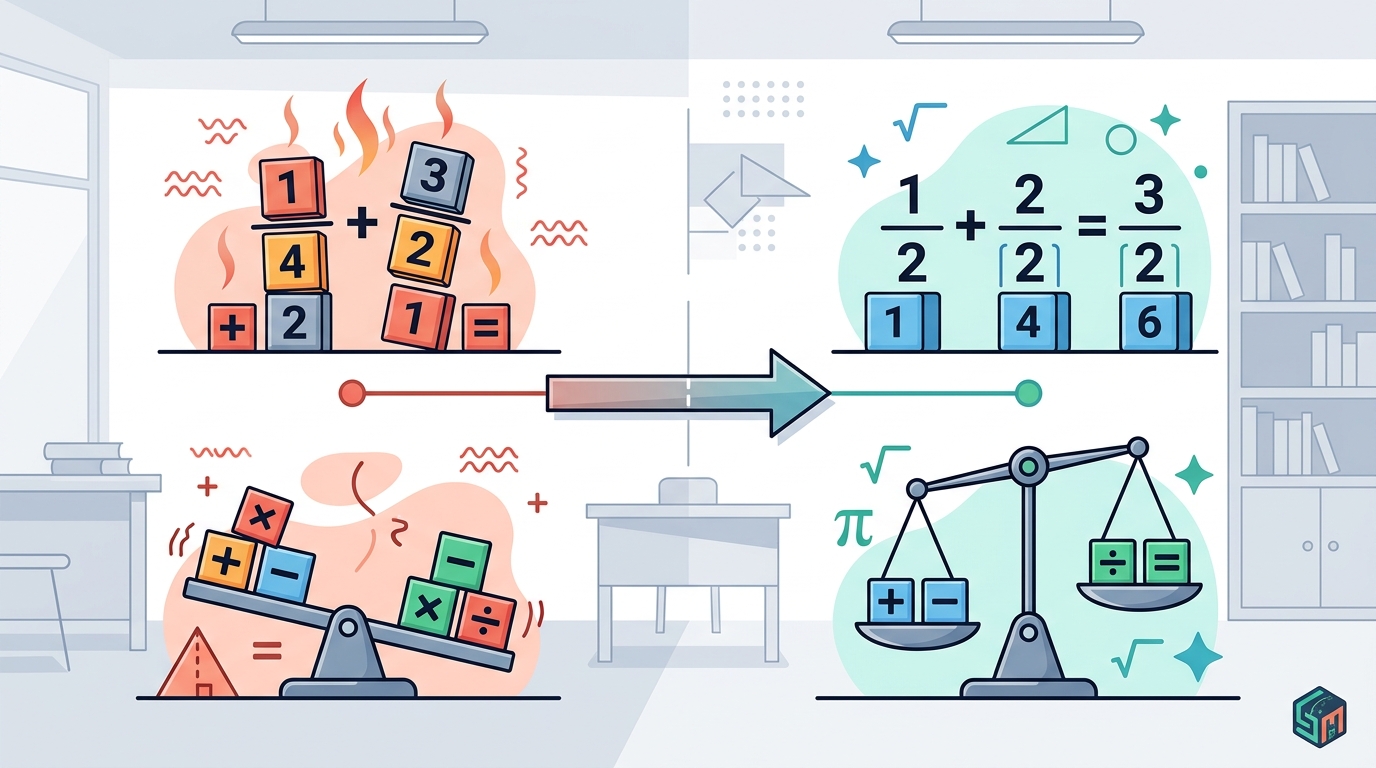
Error Analysis Comparison
Understanding the difference between conceptual and procedural errors is key to effective tutoring. The table below outlines common mistakes and their corresponding solutions.
| Error Type | Common Mistake | Corrective Strategy |
|---|---|---|
| Algebraic | Incorrect distribution of terms | Visualizing the multiplier reaching every term |
| Arithmetic | Mishandling negative signs | Using color-coding for positive and negative values |
| Word Problems | Rushing to calculate without context | Step-by-step translation of text to equations |
| Geometry | Confusing area and perimeter formulas | Relating formulas to physical space and units |
Key Takeaways
- Math anxiety is a widespread issue affecting over 60 percent of students, but it can be overcome with the right support.
- Michael J. Murphy, M.A., brings over 35 years of classroom experience to help students master mathematical concepts.
- Algebraic errors often stem from a misunderstanding of the distributive property and negative sign rules.
- Arithmetic mistakes are frequently due to attention lapses rather than a lack of knowledge.
- Word problems require a systematic approach to translate text into mathematical expressions accurately.
- Got Math Tutoring offers both in-person and online sessions in the Akron, Ohio area.
- The rate for private tutoring is $100 per hour, with a sliding scale available based on need.
Frequently Asked Questions
What subjects does Got Math Tutoring cover?
Got Math Tutoring covers a wide range of subjects, including pre-algebra, algebra, geometry, trigonometry, and calculus. We tailor our instruction to meet the specific needs of each student.
How much does tutoring cost?
The standard rate is $100 per hour. However, we offer a sliding scale based on financial need and commitment. We believe in making quality education accessible to all serious students.
Do you offer online tutoring?
Yes, we offer both in-person and online tutoring services. Online sessions are conducted via secure video conferencing platforms to ensure a seamless learning experience.
Is there a free consultation?
Yes, the first consultation is free. This allows us to assess the student's needs and determine if we are a good fit for their learning journey.
What is your teaching philosophy?
Our philosophy centers on understanding over memorization. We believe that true mathematical proficiency comes from grasping underlying concepts and developing critical thinking skills.
How do you handle math anxiety?
We address math anxiety by fostering a growth mindset. We help students view mistakes as essential parts of the learning process and build their confidence through incremental success.
Where are you located?
We are located in the Akron, Ohio area. We serve students from various schools and backgrounds, providing personalized support to help them succeed.
Contact Got Math
Ready to overcome your math challenges? Contact Michael J. Murphy, M.A., today to schedule your free consultation. Let us help you turn "I hate math" into "I can do this!" Visit our contact page to get started on your path to mathematical success.