

Math anxiety affects a significant portion of students, often stemming from a fear of failure rather than a lack of ability. Recent educational data indicates that over 60% of students experience some level of math anxiety, which can severely impede their academic progress. The traditional model of tutoring has long been dominated by face-to-face interactions, but the digital age has introduced a robust alternative. For parents and students in the Akron, Ohio area, and beyond, the question is no longer just about access, but about efficacy. Can a virtual session truly replicate the benefits of a physical classroom? The answer lies in understanding how different teaching methodologies adapt to different mediums. (Home)
Understanding the Methodologies
Mathematical learning is both cumulative and cyclical. It builds like a tower, while also spiraling back to revisit and deepen earlier ideas. This fundamental concept applies regardless of whether the student is sitting across from a tutor or viewing them on a screen. The core of effective tutoring is not the physical proximity, but the quality of the interaction. True understanding comes from mathematical thinking, not just completing procedures.
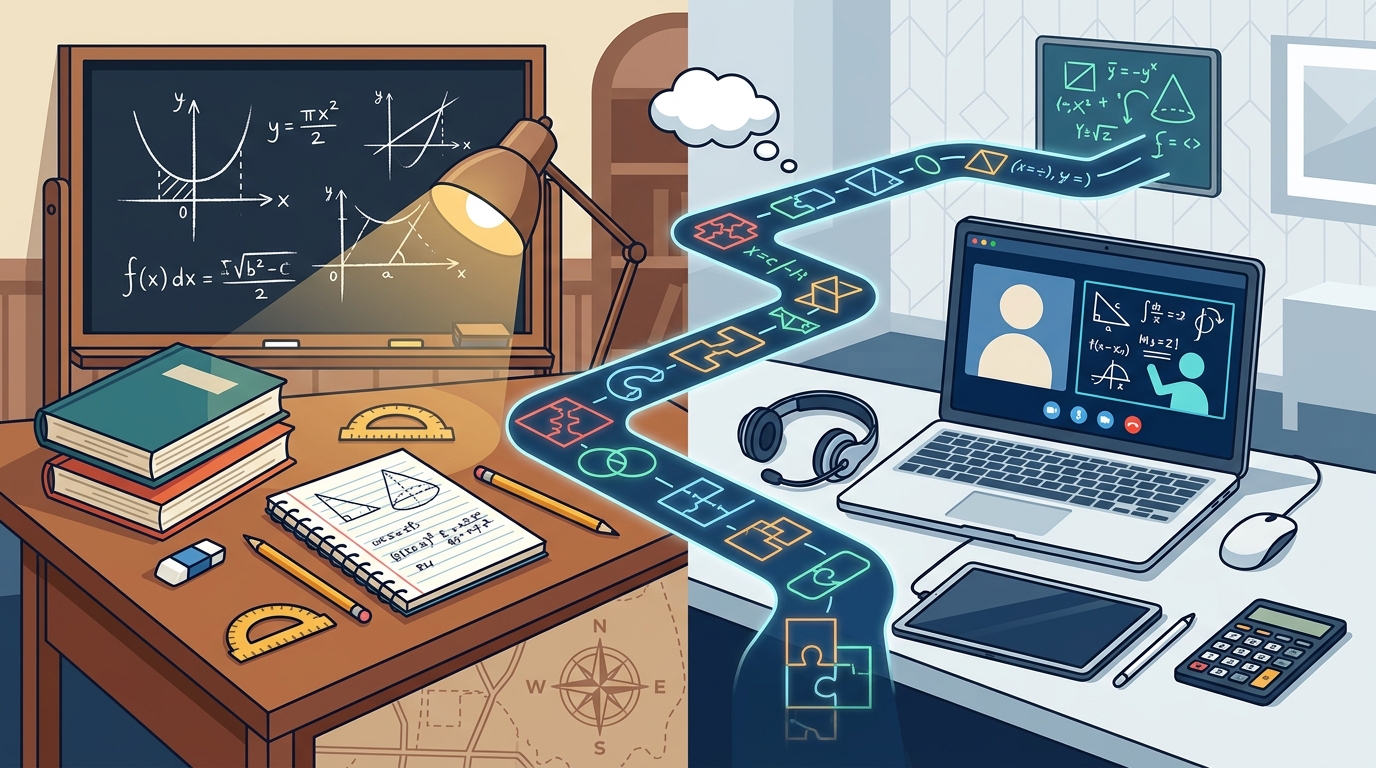
In an in-person setting, the tutor can physically guide a student's hand, point to specific parts of a written equation, and read body language with immediate clarity. This tactile feedback loop is valuable for younger students or those who struggle with spatial reasoning. However, the definition of effective tutoring must evolve. Mathematical thinking is the process of analyzing problems logically to find a solution. This skill is cultivated through dialogue, questioning, and practice, all of which can occur seamlessly in a digital environment. (Home)
Online tutoring removes the barrier of travel time, allowing for more frequent and consistent sessions. Consistency is a critical factor in overcoming math anxiety. When a student can engage with their tutor immediately after a difficult school day, the momentum of learning is preserved. This immediacy is often harder to achieve with rigid in-person schedules.
The Impact of Technology on Learning
Modern educational technology has bridged the gap between virtual and physical classrooms. Interactive whiteboards, screen sharing, and digital manipulatives allow tutors to visualize complex concepts in ways that traditional chalkboards cannot. For example, a tutor can dynamically adjust variables in a graph to show real-time changes, helping students grasp abstract algebraic concepts.
According to research on digital learning environments, students who engage with interactive digital tools often demonstrate higher levels of retention compared to passive learning methods. The ability to record sessions also provides a unique advantage. Students can review the explanation later, reinforcing the neural pathways formed during the lesson. This aligns with the principle that neurons that fire together wire together, meaning that repeated exposure to correct problem-solving strategies strengthens the brain's ability to recall them.
Furthermore, online platforms often integrate seamlessly with school curricula. Tutors can access digital textbooks and worksheets instantly, ensuring that the tutoring session is directly aligned with what the student is learning in class. This synchronization reduces confusion and helps students see the practical application of their homework.
Psychological Factors and Engagement
One of the most significant challenges in math education is the psychological barrier. Many students believe they "will never get math" due to past failures. A key part of learning mathematics is learning how to ask good questions. In a comfortable home environment, students may feel less intimidated to admit what they do not understand. This safety net is crucial for developing a growth mindset.
For students who believe they are incapable, the transition from a fixed mindset to a growth mindset is vital. Growth mindset is the belief that abilities can be developed through dedication and hard work. Online tutoring facilitates this by allowing the tutor to focus entirely on the student's thought process without the distractions of a crowded classroom. The tutor can explicitly teach mathematical "habits of mind," providing a toolbox of thinking skills that students can apply in new contexts.
However, in-person sessions offer a different kind of engagement. The physical presence of a mentor can be incredibly motivating for some students. The ability to see a tutor's facial expressions and gestures can help build a stronger personal connection. This connection is often the foundation of trust, which is essential for overcoming math anxiety. Math anxiety is a feeling of tension and fear that interferes with the manipulation of numbers and the solving of mathematical problems. For some, the personal touch of an in-person tutor is the key to unlocking their confidence.
Comparing the Options
Choosing between online and in-person tutoring depends on the individual needs of the student. Both modalities have distinct advantages and are effective when delivered by a qualified professional. The following table summarizes the key differences to help you make an informed decision.
| Feature | In-Person Tutoring | Online Tutoring |
|---|---|---|
| Convenience | Requires travel and scheduling around physical availability. | Flexible scheduling from any location with internet access. |
| Interaction Style | Tactile, immediate physical feedback, and strong personal connection. | Digital tools, screen sharing, and recorded sessions for review. |
| Focus Environment | Dependent on the tutor's office environment. | Controlled, familiar home environment can reduce anxiety. |
| Cost Efficiency | May include travel fees or higher overhead costs. | Often more affordable due to reduced overhead. |
It is important to note that the effectiveness of either method relies heavily on the tutor's expertise. A master teacher knows how to adapt their communication style to the medium. Whether through a physical whiteboard or a digital canvas, the goal remains the same: to help every student realize that they are capable of learning mathematics.
Key Takeaways
- Expertise Matters Most: Michael J. Murphy brings over 35 years of classroom experience to both online and in-person sessions, ensuring high-quality instruction regardless of the platform.
- Growth Mindset is Critical: Effective tutoring helps students move from a fixed mindset to a growth mindset, proving that intelligence can develop with effort.
- Technology Enhances Learning: Digital tools allow for dynamic visualization of concepts, aiding in the understanding of abstract mathematical ideas.
- Accessibility Reduces Anxiety: Online tutoring offers flexibility that can help students who struggle with math anxiety feel more comfortable and engaged.
- Personalized Approach: The best method depends on the student's learning style. Some thrive on physical interaction, while others prefer the comfort of their home.
- Proven Results: Former students of this tutoring service have gone on to become engineers, teachers, and Ivy League graduates, demonstrating the long-term impact of effective math education.
- Sliding Scale Options: To ensure accessibility, sliding scale rates are available based on need and commitment, making quality tutoring more affordable.
Frequently Asked Questions
Is online tutoring as effective as in-person tutoring?
Yes, online tutoring can be just as effective as in-person tutoring. The key factors are the tutor's expertise and the student's engagement. With the right tools and a structured approach, virtual sessions can provide deep mathematical understanding and support.
What age groups benefit most from online math tutoring?
Online tutoring is beneficial for students of all ages, from elementary school to college prep. Younger students may benefit from the interactive digital tools, while older students often appreciate the flexibility and the ability to review recorded sessions.
How do you handle math anxiety in a virtual setting?
Math anxiety is addressed by creating a safe, non-judgmental environment. Tutors focus on building confidence through small wins and by teaching students how to track their errors and learn from them. The comfort of home can also help reduce the pressure some students feel in a formal setting.
What technology is required for online tutoring?
Students need a stable internet connection, a device with a camera and microphone, and a digital whiteboard application. The tutor will guide the student through the setup process to ensure a smooth experience.
Can online tutoring help with specific math subjects?
Absolutely. Online tutoring can cover a wide range of subjects, including arithmetic, algebra, geometry, trigonometry, and calculus. The tutor can adapt the curriculum to meet the specific needs of the student.
Is there a sliding scale for online tutoring?
Yes, sliding scale rates are available for online tutoring based on need and commitment. This ensures that quality math education is accessible to a wider range of families.
How do I schedule a consultation?
You can schedule a free first consultation by contacting the tutor directly. This initial meeting helps determine if the online or in-person format is the best fit for your child's learning style.
Start Your Journey
Whether you choose online or in-person tutoring, the goal is to transform your child's relationship with mathematics. With over 35 years of experience, Michael J. Murphy is dedicated to helping students achieve their full potential. The first step is a conversation. Contact Got Math Tutoring today to schedule your free consultation and discover how effective math tutoring can change your student's future.