

Endless worksheets often reinforce rote memorization rather than true understanding. To help your child grasp a math concept again, you must shift from procedural drilling to conceptual re-explanation. This approach focuses on the "why" behind the steps, using visual models and real-world context. Got Math Tutoring specializes in this method, helping students turn confusion into confidence without relying on repetitive drills.
Why Worksheets Fail to Build Understanding
Research in cognitive science suggests that desirable difficulties are more effective than easy repetition. A desirable difficulty is a learning task that feels harder in the moment but leads to better long-term retention. Worksheets rarely provide this. They provide easy, low-cognitive-load tasks that feel productive but do not build deep neural pathways. Science explains how children best learn math, highlighting the importance of understanding concepts over rote speed.
For a parent, the implication is clear. If your child is stuck, stopping the worksheets is the first step. You need a different tool. You need a conversation that breaks the concept down into its smallest parts. If you have questions about how to approach this, you can reach out to a tutor for guidance.
The Power of Re-Explanation
Re-explanation is the act of teaching a concept back to the learner using different language or models. It is not about giving the answer. It is about changing the angle of attack. When a student cannot understand a concept, it is often because the initial explanation did not match their learning style.
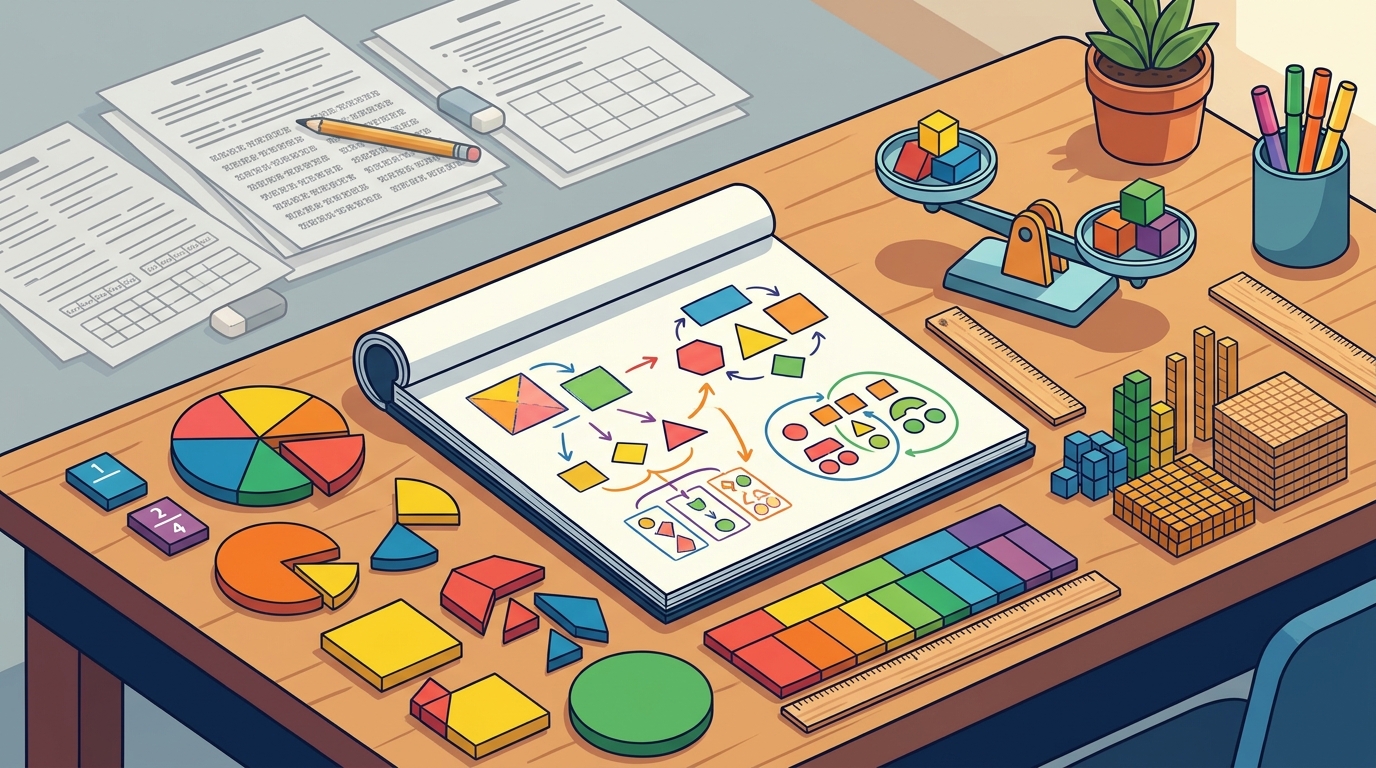
Consider the concept of fractions. A student might understand 1/2 as a slice of pizza. But they may fail when asked to add 1/2 and 1/4. The gap is not in arithmetic. It is in the concept of equivalent units. A tutor or parent can re-explain this by using physical objects. They might use two different sized blocks to show that two small blocks equal one large block. This visual re-explanation bridges the gap.
Visual and Concrete Models
Abstract math symbols are the final step in learning. They are not the first step. For many students, jumping straight to symbols causes cognitive overload. You need to move from concrete to visual to abstract. This is known as the CPA approach.
Concrete means using physical objects. Visual means using diagrams or number lines. Abstract means using numbers and symbols. If your child is stuck on an abstract problem, go back to the concrete. Use coins for money problems. Use blocks for area and perimeter. Use a number line for addition and subtraction.
This method is not Learn more: Contact.