

Math anxiety affects a significant portion of students, often stemming from a fear of making errors rather than a lack of ability. According to recent educational data, nearly 60% of students report feeling stressed when approaching mathematics problems. This stress creates a mental block that prevents clear thinking and leads to avoidable mistakes. The good news is that these errors are rarely signs of low intelligence. They are usually symptoms of bad habits, rushed work, or misunderstood concepts. By identifying these patterns, students can transform their relationship with math from one of fear to one of confidence.
Understanding the Problem Before Solving
One of the most frequent causes of failure in mathematics is rushing into calculations without fully grasping what is being asked. Students often skim the question, grab the first numbers they see, and begin operating. This approach ignores the context of the problem entirely. Math is a language that requires precise reading before it can be spoken. Taking the time to restate the problem in your own words ensures that you are solving the right equation.
Michael J. Murphy, a master teacher with over 35 years of classroom experience, emphasizes that true understanding comes from mathematical thinking, not just completing procedures. When students slow down to analyze the structure of a problem, they engage their critical thinking skills. This habit of mind is essential for success in life and in advanced mathematics. It shifts the focus from getting the "right answer" quickly to understanding the "why" behind the numbers.
For students in the Akron, Ohio area, or those connecting online, learning to pause and reflect is a skill that can be taught. A tutor can help identify where the breakdown in understanding occurs. Is it a vocabulary issue? A conceptual gap? Or simply a habit of haste? Contact Michael Murphy to discuss how we can address these specific hurdles together.
Sign and Order of Operations Errors
Algebra introduces a new layer of complexity with negative numbers and abstract variables. A common mistake here is mishandling signs. Students often forget that subtracting a negative number is the same as adding a positive one. This error cascades through the rest of the problem, leading to incorrect results despite correct logic. Another frequent issue is the order of operations. Many students calculate from left to right without regard for parentheses or exponents.
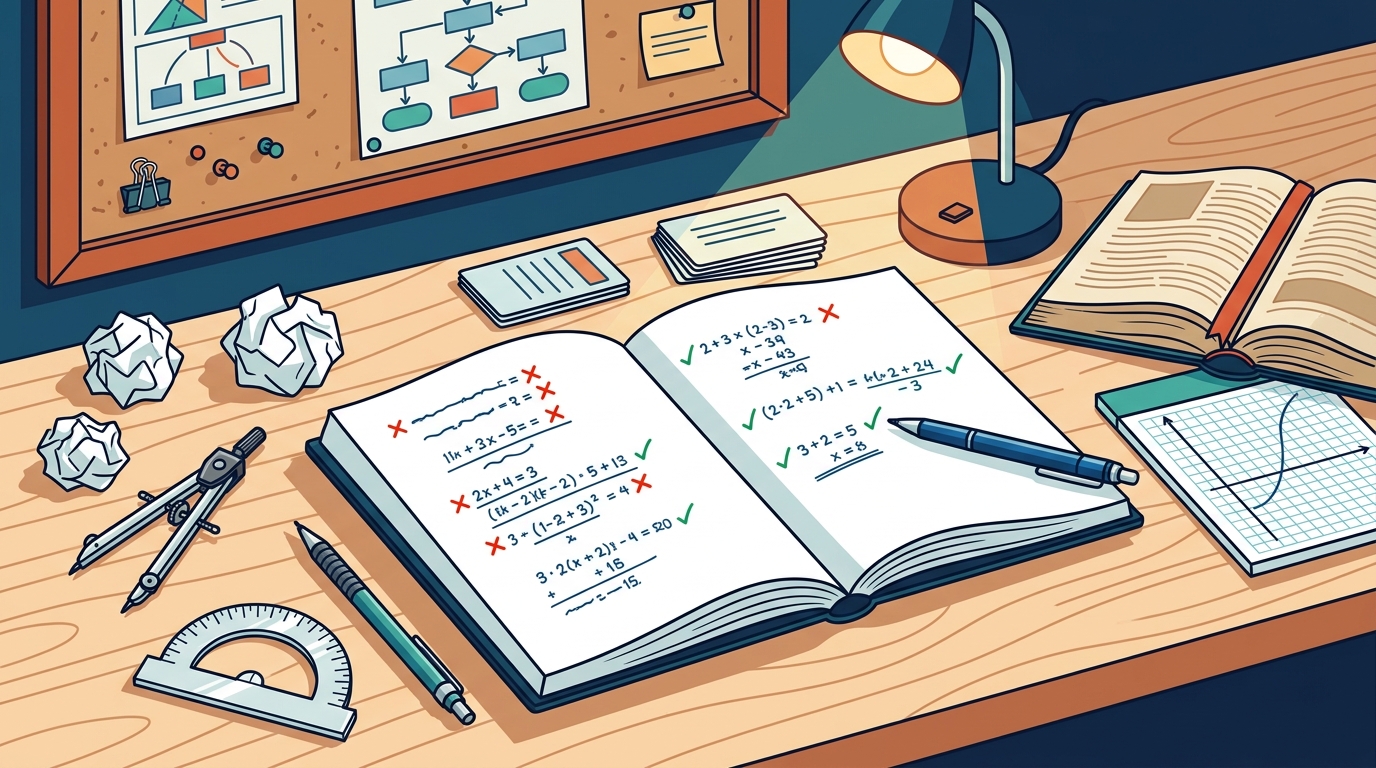
To fix this, students must internalize the hierarchy of operations. PEMDAS (Parentheses, Exponents, Multiplication/Division, Addition/Subtraction) is not just a rhyme; it is a rule of precedence. When solving complex equations, writing out each step clearly helps prevent sign errors. Tracking your errors and looking for patterns is a powerful technique. If you consistently miss a negative sign, it is likely an attention issue, not a math issue.
Michael’s approach to teaching mathematics emphasizes understanding, not just procedures. He helps students develop a toolbox of thinking skills and problem-solving strategies they can apply in new contexts. This method is particularly effective for high school students struggling with algebra. You can view his professional background and teaching philosophy on his resume page.
Strengthening Arithmetic Fundamentals
Even in advanced math, basic arithmetic errors can derail progress. Fractions, decimals, and percentages are common stumbling blocks. For example, adding fractions with different denominators without finding a common denominator is a classic error. Similarly, misplacing decimal points during multiplication or division can change the magnitude of an answer by orders of magnitude.
These mistakes often stem from a lack of fluency in the basics. If you have to struggle with the arithmetic, you have less mental energy for the conceptual problem. Regular practice with foundational skills is essential. However, rote memorization is not the only path. Understanding the logic behind fraction operations makes them easier to remember. Mathematical learning is both cumulative and cyclical, building like a tower while spiraling back to revisit and deepen earlier ideas.
For students who believe they "will never get math," the goal is to move gradually from a fixed mindset toward a growth mindset. Making mistakes is not only acceptable; it is essential. Mistakes help the brain grow. We now know that the brain is plastic, not static, and that ability and intelligence can develop with effort and practice. The idea that "neurons that fire together wire together" explains how new neural pathways are formed when students struggle productively and learn from errors.
Strategies for Word Problems
Word problems are often the most dreaded part of mathematics. They require translating text into symbols, a skill that demands both linguistic and mathematical proficiency. A common mistake is ignoring key information or misinterpreting the relationship between quantities. Students might see the words "more than" and immediately add, without considering the context.
Effective strategies include underlining key numbers, circling the question, and drawing diagrams. Visualizing the problem can make abstract relationships concrete. For instance, drawing a bar model for a ratio problem can clarify the steps needed to solve it. Learning to "pay attention to your attention" (self-monitoring) and to "think about your thinking" (metacognition) are powerful skills that benefit students far beyond math.
Michael’s students often report that he helps them find their footing and confidence in math. He genuinely makes them feel available and interested in their success. This supportive environment is crucial for tackling difficult word problems. If you or your child are struggling with these concepts, a free first consultation can help determine if private tutoring is the right fit.
Comparison of Remediation Approaches
There are several ways to address common math mistakes. Each approach has its strengths depending on the student's needs.
| Approach | Best For | Key Benefit |
|---|---|---|
| Self-Study | Students with high discipline | Flexible scheduling and low cost |
| Online Platforms | Visual learners | Immediate feedback and gamification |
| Private Tutoring | Students with specific gaps | Personalized instruction and mindset shift |
| Peer Study Groups | Social learners | Collaborative problem solving |
While online platforms offer great practice, they cannot address the underlying mindset issues that often cause math anxiety. Private tutoring provides a space to ask "stupid" questions without judgment. It allows for a deep dive into the "why" behind the math. Michael’s sliding scale pricing makes this personalized support accessible to more families. Reach out today to learn more about the sliding scale options.
Key Takeaways
- Slow Down: Rushing is the primary cause of avoidable errors. Read the problem twice before starting.
- Track Errors: Keep a log of mistakes to identify patterns. Are they sign errors? Calculation errors? Conceptual gaps?
- Growth Mindset: Mistakes are essential for brain growth. Embrace the struggle as part of learning.
- Visualize: Use diagrams and models to make abstract word problems concrete.
- Master Basics: Fluency in arithmetic frees up mental energy for complex problem solving.
- Expert Guidance: A master teacher with 35+ years of experience can accelerate progress significantly.
- Free Consultation: Michael Murphy offers a free first consultation to assess needs and fit.
Frequently Asked Questions
How much does private math tutoring cost?
The standard rate is $100 per hour. However, a sliding scale is available based on need and commitment to ensure accessibility for serious students.
Do you offer online tutoring?
Yes, Michael offers both in-person tutoring in the Akron, Ohio area and online sessions to accommodate different learning preferences and locations.
What subjects do you cover?
Michael covers a wide range of subjects, from foundational arithmetic to advanced high school mathematics. Specific subject areas can be discussed during the consultation.
Is the first consultation really free?
Yes, the first consultation is completely free. It is designed to determine if Michael is a good fit for the student and to discuss their specific goals.
How do I contact Michael Murphy?
You can contact Michael via the contact form on the website or by emailing him directly. He typically responds within a few hours.
What is Michael's teaching philosophy?
He believes that every student is capable of learning mathematics. His approach emphasizes understanding concepts through meaningful problem solving rather than just memorizing procedures.
Can tutoring help with math anxiety?
Absolutely. Michael is known for turning "I hate math" into "I can do this!" by helping students build confidence and develop a growth mindset.
Start Your Journey
Don't let common math mistakes hold you back. With the right strategies and guidance, you can overcome these hurdles and build a strong foundation for future success. Michael J. Murphy is dedicated to helping students achieve their potential through personalized, understanding-based instruction.
Take the first step today. Contact Michael Murphy to schedule your free consultation and discover how private tutoring can transform your math experience.