
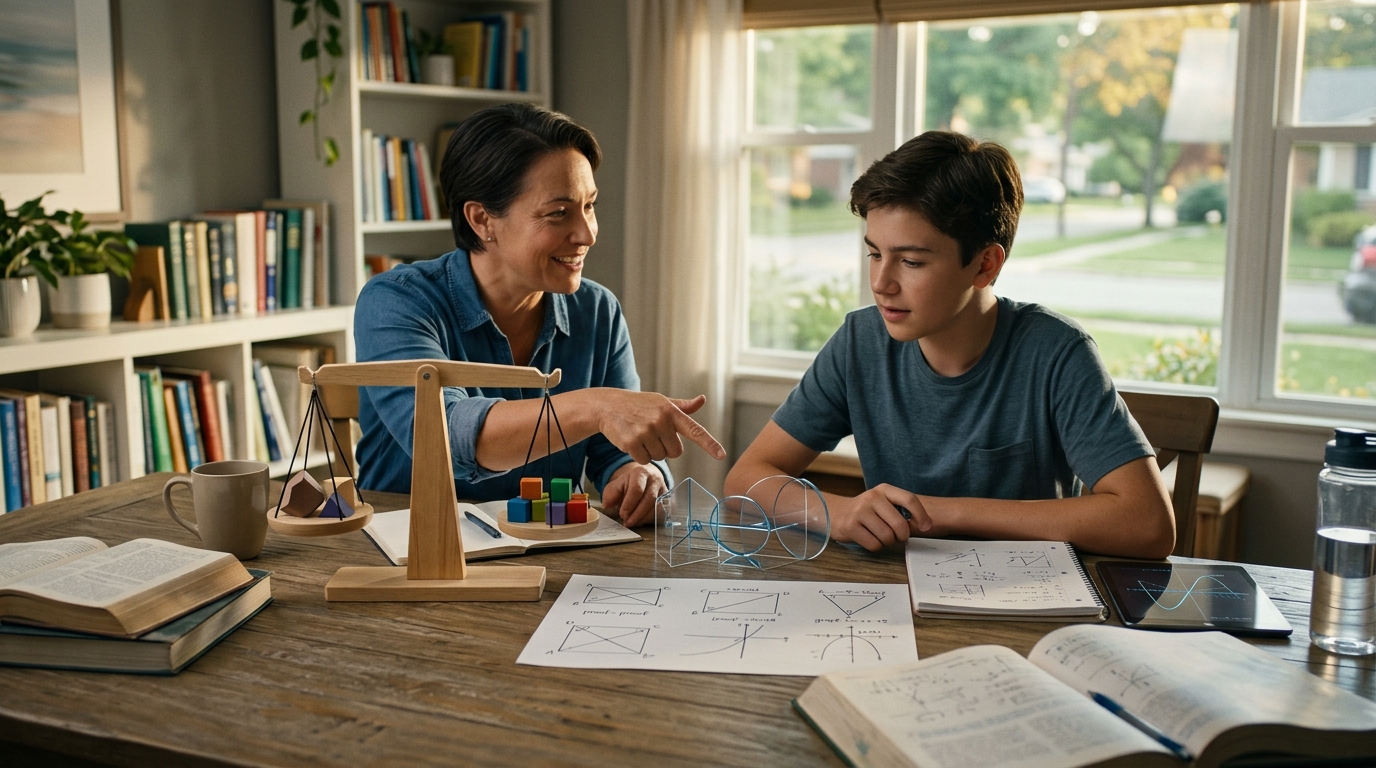
Yes, a private math tutor can effectively re-explain classroom concepts without relying on drill worksheets. By using conversational dialogue, visual models, and real-time adaptation, tutors help students build deep conceptual understanding rather than rote memorization. This guide explores how personalized pacing and alternative teaching methods replace repetitive practice with meaningful learning strategies.
Concept Re-Explanation
Concept re-explanation is the process of breaking down a mathematical idea into its fundamental components to ensure true comprehension. In a traditional classroom, a teacher might explain a concept once to thirty students. If a student misses the core logic, they often move on to the next problem without resolving the gap. A private tutor changes this dynamic by pausing the workflow to rebuild the foundation.
Why Standard Explanations Fail
Standard classroom explanations often rely on procedural steps. Students learn to follow a sequence of operations without understanding why those operations work. This leads to fragile knowledge that breaks down when the problem format changes slightly. When a tutor re-explains the concept, they focus on the "why" rather than just the "how."
The Role of Dialogue
Effective re-explanation is a two-way conversation. The tutor asks the student to explain their thinking. This reveals where the misconception lies. Instead of correcting the student with a worksheet, the tutor guides them to identify the error themselves. This active engagement creates stronger neural pathways than passive reading or copying.
At gotmath tutoring, the focus is on turning "I hate math" into "I can do this." This shift happens when the student understands the logic behind the numbers. The tutor acts as a guide, not just an answer key.
Personalized Pacing
Personalized pacing is the adjustment of instructional speed to match the student's current level of understanding. In a large classroom, the pace is set by the curriculum and the average student. This often leaves struggling students behind and bored advanced students. A private tutor removes this constraint entirely.

Slowing Down for Depth
When a student struggles, the tutor slows down. They spend more time on the underlying principles. This might mean reviewing prerequisite skills from previous grades. This depth of review is impossible in a standard classroom setting. The student feels supported rather than rushed.
Speeding Up for Mastery
Conversely, if a student grasps a concept quickly, the tutor accelerates. They introduce more complex applications or enrichment problems. This keeps high-achieving students engaged. It prevents the boredom that often leads to disengagement in advanced courses. The pace is always dictated by the student's readiness.
This flexibility is a core component of the services offered by gotmath tutoring. The tutor works with any student who is serious about applying themselves. The sliding scale approach allows for commitment-based scheduling that fits the student's needs.
Alternative Teaching Methods
Visual Models and Manipulatives
Visual models help students see the structure of a problem. For example, using area models for multiplication or bar diagrams for word problems makes abstract relationships concrete. These tools allow students to manipulate ideas before translating them into algebraic notation. This builds a robust mental framework.
Verbal Reasoning and Communication
Verbal reasoning requires students to explain their steps in plain language. This forces them to articulate their logic. It highlights gaps in understanding that might be hidden by correct procedural steps. Clear communication is a key skill in mathematics, and tutors emphasize it in every session.
These methods align with the philosophy of gotmath tutoring, which emphasizes mathematical thinking and problem solving. The goal is not just to get the right answer, but to understand why the answer is correct.
Real-Time Adaptation
Real-time adaptation is the immediate adjustment of teaching strategies based on the student's responses during a session. Unlike pre-planned worksheets, this approach is dynamic. The tutor observes the student's facial expressions, hesitation, and verbal cues. They adjust the explanation on the fly.
Identifying Misconceptions Instantly
If a student makes a specific error, the tutor identifies the root cause immediately. They might switch from a procedural explanation to a visual one. This prevents the student from practicing the wrong method repeatedly. It saves time and reduces frustration.
Building Confidence Through Success
Real-time adaptation allows the tutor to scaffold problems appropriately. They start with a problem the student can solve. Then they gradually increase the difficulty. This sequence of small successes builds confidence. It counters math anxiety by creating a positive learning environment.
This dynamic interaction is a hallmark of the one-on-one instruction provided by gotmath tutoring. The tutor is not just delivering content; they are responding to the learner in real time.
Comparison of Approaches
The table below summarizes the differences between traditional worksheet-based practice and concept-driven tutoring.
| Pacing | Fixed, uniform for all students | Dynamic, adjusted to individual needs |
| Feedback | Delayed, often self-corrected | Immediate, guided by tutor |
| Focus | Procedural repetition | Conceptual understanding and logic |
| Adaptability | Static content | Real-time strategy shifts |
| Outcome | Short-term retention | Long-term problem-solving skills |
Key Takeaways
- Private tutors can re-explain concepts without worksheets by using dialogue and visual models.
- Personalized pacing allows tutors to slow down for depth or speed up for mastery.
- Alternative methods like verbal reasoning build stronger conceptual foundations than rote memorization.
- Real-time adaptation enables tutors to correct misconceptions immediately during a session.
- Concept-driven tutoring fosters a growth mindset and reduces math anxiety.
- One-on-one instruction provides the individualized attention that large classrooms cannot offer.
- Students who understand the "why" of mathematics are better prepared for advanced courses.
- Effective tutoring focuses on building confidence and lasting problem-solving skills.
Frequently Asked Questions
Can a tutor help a student who has failed a math class?
Yes. A tutor can identify the specific gaps in understanding that led to the failure. By re-explaining foundational concepts, the student can rebuild their knowledge base. This approach is more effective than simply practicing new material.
Do you use worksheets in your tutoring sessions?
While worksheets may be used occasionally for practice, the primary focus is on conceptual understanding. The tutor uses dialogue, visual models, and real-time adaptation to ensure the student grasps the core ideas. The goal is to minimize reliance on rote drills.
How does personalized pacing work in practice?
The tutor assesses the student's level at the start of each session. If the student struggles, the tutor slows down and reviews prerequisites. If the student excels, the tutor introduces more challenging problems. This ensures the student is always working at an optimal level of challenge.
Is this approach suitable for gifted students?
Yes. Gifted students often need enrichment and greater challenge. A tutor can provide this by exploring deeper mathematical connections and complex problem-solving scenarios. This keeps advanced students engaged and motivated.
How does a tutor handle math anxiety?
A tutor creates a low-pressure environment. They focus on the process of thinking rather than just the correct answer. By building confidence through small successes, the tutor helps the student overcome their fear of mathematics.
What is the difference between homework help and concept tutoring?
Homework help often focuses on completing assignments. Concept tutoring focuses on understanding the underlying principles. A concept tutor ensures the student can apply the knowledge to new problems, not just the ones in the textbook.
Conclusion
A private math tutor can effectively re-explain classroom concepts without relying on drill worksheets. By leveraging personalized pacing, alternative teaching methods, and real-time adaptation, tutors build deep conceptual understanding. This approach transforms students from passive recipients of information into active mathematical thinkers. For parents and students seeking a tutor who explains why mathematics works, gotmath tutoring offers a proven path to confidence and success. To plan your visit, .