
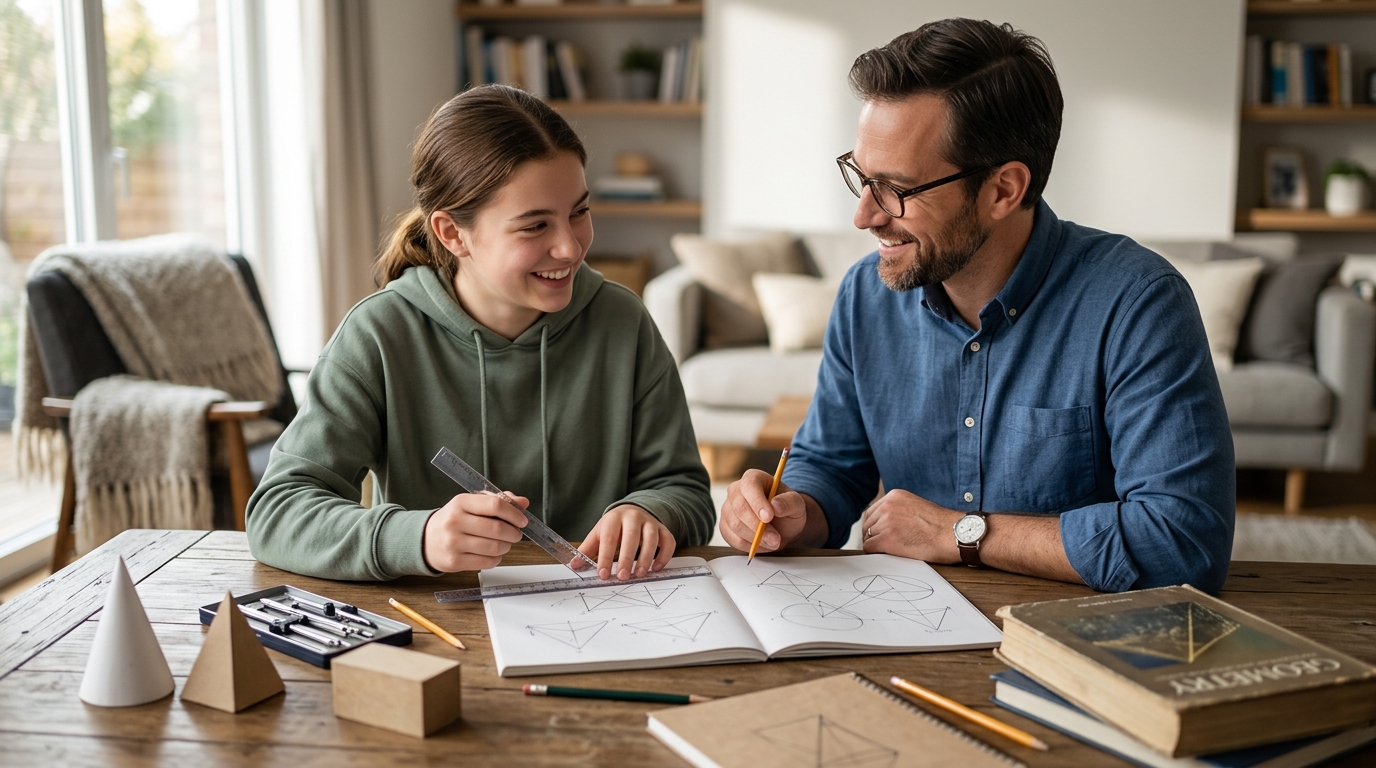
Students can move past rote memorization by shifting their focus from memorizing isolated formulas to understanding the logical relationships between geometric shapes and theorems. This approach builds a flexible mental framework that allows learners to solve novel problems rather than just recall standard ones. This guide explores five critical strategies for mastering high school geometry, including conceptual understanding, proof writing, visual exploration, real-world application, and error analysis. It is designed for students and parents seeking a deeper, more durable mathematical foundation. For additional details, review the .
Building Conceptual Understanding
Rote memorization is the process of committing information to memory without understanding its underlying meaning or logic. In geometry, this often manifests as students memorizing the formula for the area of a trapezoid without knowing why it works. When a student encounters a modified problem, such as a trapezoid with a missing side, the memorized formula fails. Conceptual understanding is the ability to explain the 'why' behind a mathematical rule. It transforms static formulas into dynamic tools.
Deconstructing Formulas
Instead of memorizing the area of a circle as A = pi r squared, students should understand that this formula is derived from the relationship between the circle's radius and its circumference. By deconstructing formulas, students can reconstruct them if they forget the exact notation. This method relies on logical deduction rather than recall. It ensures that knowledge remains accessible even under test pressure.
Connecting Theorems
Geometry is a web of interconnected theorems. The Pythagorean theorem is not just a tool for right triangles; it is a special case of the Law of Cosines. Understanding these connections creates a robust mental map. When students see how theorems relate to one another, they stop viewing geometry as a list of disjointed rules. They begin to see it as a coherent system of logic.
The Power of Geometric Proofs
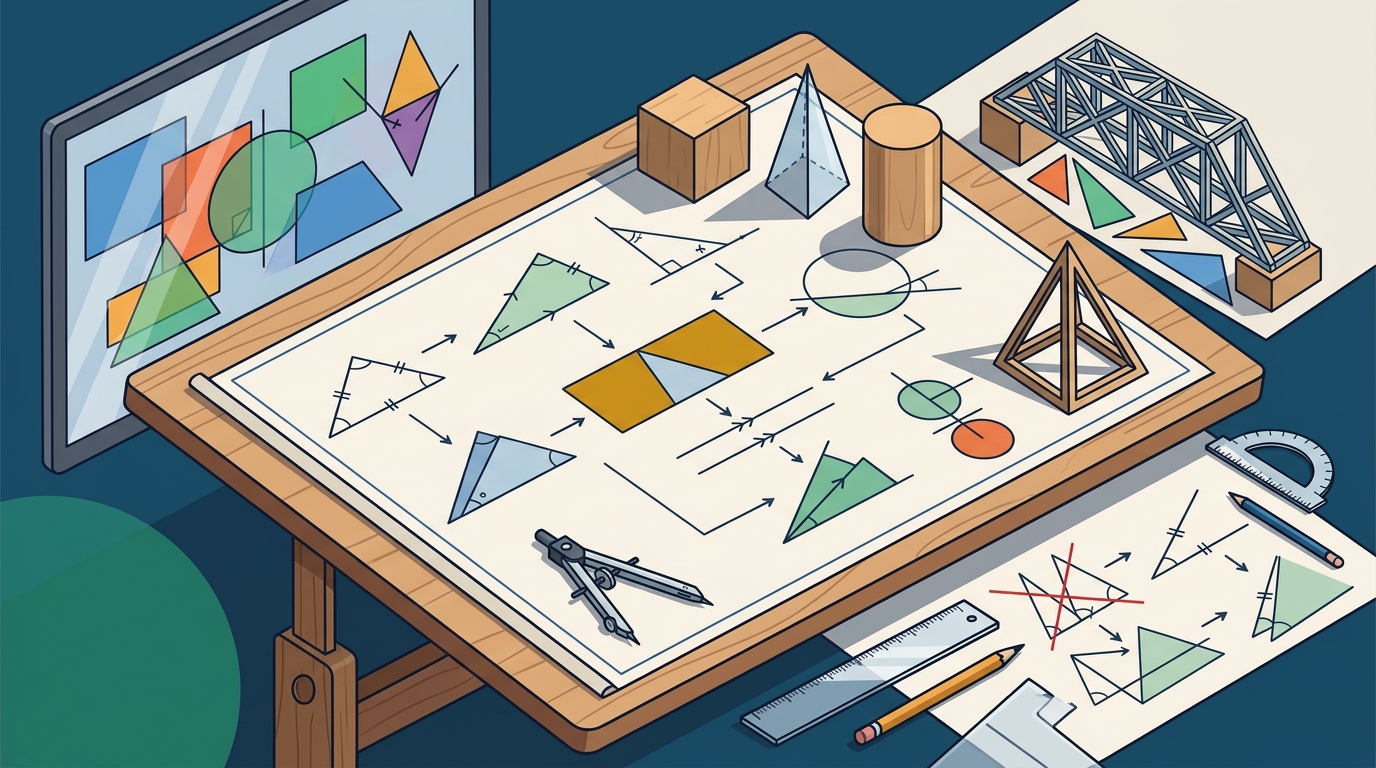
A geometric proof is a logical sequence of statements that demonstrates the truth of a geometric claim. Proofs are often the most intimidating part of high school geometry for students who rely on memorization. However, proofs are the ultimate test of conceptual understanding. They require students to articulate their reasoning clearly and precisely. Mastering proofs forces students to move beyond guessing the answer and toward justifying it.
Logical Structure
Every proof follows a strict logical structure. It begins with given information and ends with a conclusion. Each step must be justified by a specific theorem, definition, or postulate. This structure mirrors the way scientists and engineers build arguments. It teaches students to think critically and communicate their ideas with precision. This skill is transferable to many other academic and professional fields.
Overcoming the Blank Page
Many students freeze when faced with a blank proof. To overcome this, students should practice working backward from the conclusion. By identifying what is needed to prove the final statement, they can work their way back to the given information. This reverse-engineering technique reduces anxiety and provides a clear path forward. It turns a daunting task into a manageable puzzle.
Visual Exploration and Spatial Reasoning
Spatial reasoning is the ability to understand and manipulate objects in three-dimensional space. Geometry is inherently visual, yet many students struggle to translate two-dimensional diagrams into three-dimensional mental models. Visual exploration involves actively manipulating shapes to see how they change. This can be done with physical models, dynamic geometry software, or even hand-drawn sketches. Engaging with shapes visually strengthens the neural pathways associated with spatial thinking.
Dynamic Geometry
Dynamic geometry software allows students to drag vertices of a shape and observe how its properties change in real time. For example, dragging a vertex of a parallelogram shows that the opposite angles remain equal. This immediate feedback reinforces conceptual understanding. It allows students to test their hypotheses and see the consequences of their actions. This interactive approach is far more engaging than static textbook diagrams.
Physical Models
Physical models, such as paper nets for prisms and pyramids, provide a tactile connection to geometry. Folding a net into a solid helps students understand surface area and volume. It makes abstract concepts concrete and tangible. This hands-on approach is particularly effective for students who learn by doing. It bridges the gap between the abstract and the physical world.
Connecting Geometry to the Real World
Real-world connections are applications of geometric principles to practical problems in fields such as architecture, engineering, and design. When students see how geometry is used to build bridges, design cars, or create video games, the subject becomes relevant and engaging. This relevance motivates students to learn more deeply. It shifts the focus from passing a test to acquiring a useful skill. Understanding the practical value of geometry fosters a growth mindset.
Architecture and Design
Architects use geometry to ensure that buildings are structurally sound and aesthetically pleasing. The use of triangles in trusses provides stability, while circles and curves create dynamic forms. By studying famous buildings, students can identify the geometric principles at work. This connection makes geometry feel less abstract and more applicable to their daily lives. It shows that math is a tool for creating the world around us.
Technology and Gaming
Video game developers use geometry to create realistic 3D environments. Understanding vectors, transformations, and perspective is essential for game design. Students interested in technology can see how geometry powers the digital experiences they enjoy. This connection can spark a deeper interest in the subject. It demonstrates that geometry is not just a school requirement but a foundation for modern innovation.
Error Analysis and Growth Mindset
Error analysis is the process of examining mistakes to understand their root causes. In geometry, errors often stem from conceptual misunderstandings rather than simple calculation slips. By analyzing errors, students can identify gaps in their knowledge and address them directly. This process is central to developing a growth mindset. It frames mistakes not as failures but as valuable learning opportunities. It encourages students to persist and improve.
Identifying Root Causes
When a student makes an error, they should ask themselves why it happened. Did they misread the problem? Did they apply the wrong formula? Did they make a calculation mistake? Identifying the root cause allows for targeted correction. This self-reflection builds metacognitive skills. It helps students become more aware of their own thinking processes. This awareness is crucial for long-term academic success.
Embracing the Struggle
Struggling with difficult problems is a natural part of learning. Students who view struggle as a sign of weakness often give up. Those who view struggle as a sign of growth are more likely to persist. By embracing the challenge, students build resilience and confidence. They learn that mastery comes from effort and persistence, not just innate ability. This mindset shift is essential for mastering complex subjects like geometry.
Key Takeaways
- Conceptual understanding is more durable than rote memorization.
- Geometric proofs develop logical reasoning and communication skills.
- Visual exploration strengthens spatial reasoning and mental modeling.
- Real-world connections make geometry relevant and engaging.
- Error analysis helps identify and correct conceptual gaps.
- A growth mindset frames mistakes as learning opportunities.
- Personalized tutoring can accelerate this transition from memorization to mastery.
Frequently Asked Questions
Why is rote memorization ineffective for geometry?
Rote memorization is ineffective because geometry problems often vary in structure. Memorized formulas do not adapt to new configurations. Conceptual understanding allows students to apply principles flexibly.
How can I improve my spatial reasoning skills?
You can improve spatial reasoning by using dynamic geometry software and physical models. These tools help you visualize how shapes change and interact. Regular practice with these tools strengthens your mental models.
What is the best way to learn geometric proofs?
The best way to learn proofs is to practice working backward from the conclusion. This technique helps you identify the logical steps needed to reach the given information. Consistent practice builds confidence and skill.
How does geometry apply to real-world careers?
Geometry is used in architecture, engineering, design, and technology. It is essential for creating stable structures and realistic digital environments. Understanding these applications can motivate students to learn more deeply.
What role does error analysis play in learning?
Error analysis helps students identify the root causes of their mistakes. This process allows for targeted correction and deeper understanding. It is a key component of developing a growth mindset.
Can tutoring help with the transition from memorization to understanding?
Yes, personalized tutoring can help students make this transition. A tutor can provide individualized feedback and guidance. They can help students identify gaps in their understanding and develop effective strategies.
Is it too late to start learning geometry if I struggled in the past?
It is never too late to start learning geometry. With the right approach and support, students can build a strong foundation at any age. A growth mindset and consistent practice are key to success.
What resources are available for visual exploration?
There are many resources available for visual exploration, including dynamic geometry software and physical models. These tools allow students to interact with shapes and see how they change. They make learning more engaging and effective.
Conclusion
Mastering high school geometry requires a shift from rote memorization to deep conceptual understanding. By focusing on the logic behind theorems, practicing proofs, exploring shapes visually, and connecting geometry to the real world, students can build a robust and flexible mathematical foundation. Error analysis and a growth mindset are essential for navigating the challenges of learning. At gotmath tutoring, we specialize in helping students make this transition. Our personalized approach ensures that each student receives the support they need to succeed. If you are ready to move beyond memorization and truly master geometry, to schedule a free consultation.