
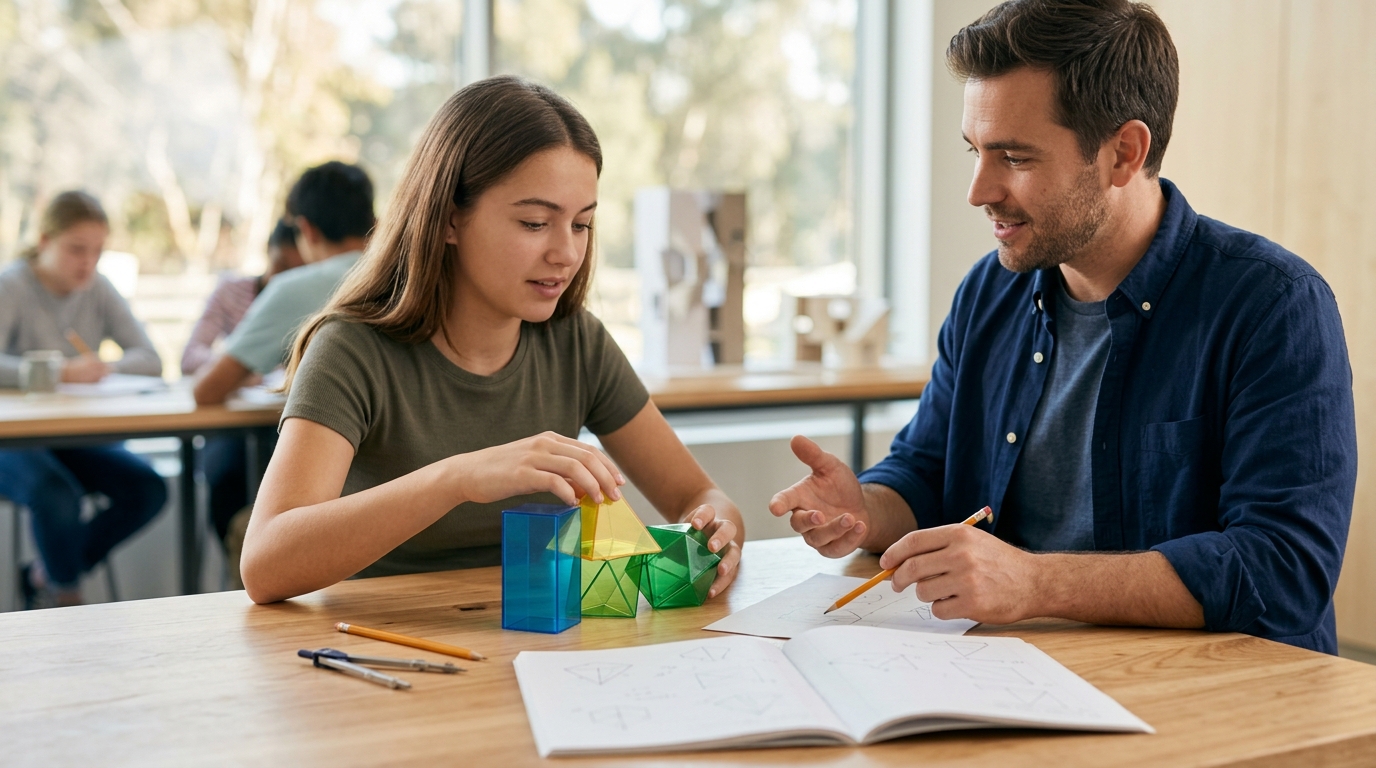
Building Geometry Mastery Through Exploration, Conjecture, and Proof
Geometry is often misunderstood as a static collection of formulas to memorize. In reality, it is a dynamic language of spatial reasoning and logical deduction. Research indicates that students who engage in active exploration rather than passive rote learning demonstrate significantly higher retention rates in mathematical concepts. This guide outlines how shifting from procedural compliance to conceptual inquiry transforms the learning experience. We will explore the pedagogical shift toward inquiry-based learning, the mechanics of forming valid conjectures, and the rigorous structure of geometric proof. By understanding these core components, students and parents can appreciate why true mastery requires more than just getting the right answer. It demands a deep understanding of the underlying logic that connects shapes, angles, and spaces. (Home)
The Pedagogical Shift: From Memorization to Inquiry
Traditional mathematics education often prioritizes speed and accuracy in calculation. However, modern educational standards emphasize mathematical thinking over mere procedure completion. This distinction is critical for geometry, where visual-spatial skills are just as important as algebraic manipulation. When students are taught to simply apply formulas like the area of a circle or the Pythagorean theorem without understanding their origins, they struggle when faced with novel problems.
Inquiry-based learning flips this model. Instead of presenting a theorem and asking for its application, the educator presents a problem that requires the theorem to be discovered. This approach aligns with the belief that every student is capable of learning mathematics. It requires patience and a willingness to sit with uncertainty. For many students, this shift is initially uncomfortable. They are used to being told exactly what to do. However, the process of grappling with a problem builds resilience. It teaches them that confusion is not a sign of failure but a necessary step in the learning process.
Michael J. Murphy, a master teacher with over 35 years of classroom experience, emphasizes that true understanding comes from mathematical thinking. His approach focuses on helping students connect new ideas to what they already know. This cumulative learning style ensures that geometry is not a series of isolated facts but a coherent structure. By focusing on meaningful problem solving, tutors can help students see the beauty in logical deduction. This method is particularly effective for students who have previously struggled with math anxiety. It replaces fear with curiosity.
The Role of Exploration in Spatial Reasoning
Exploration is the foundation of geometric intuition. Before a student can prove that two triangles are congruent, they must first understand what congruence looks like. This is where hands-on activities and dynamic geometry software become invaluable tools. Exploration allows students to manipulate shapes, change angles, and observe invariant properties. For example, dragging the vertices of a triangle and watching the sum of its angles remain constant at 180 degrees provides a visceral understanding of a theorem.
This process is known as spatial reasoning. It is the ability to visualize and manipulate objects in space. Studies in cognitive science show that spatial reasoning is a strong predictor of success in STEM fields. By encouraging exploration, educators help students develop this critical skill. It is not enough to know that a property exists. Students must see it, touch it, and test it. This tactile engagement creates stronger neural pathways than passive reading ever could.
Furthermore, exploration helps demystify the subject. When students are allowed to make mistakes during the exploration phase, they learn that errors are data points. They help identify what does not work, which narrows the path to what does. This is a crucial mindset shift. In a traditional classroom, a wrong answer is often marked with a red X. In an exploratory environment, a wrong answer is a starting point for discussion. It prompts the question, "Why did this not work?" This inquiry leads to deeper understanding. It forces the student to examine their assumptions and refine their logic.
Forming Conjectures: The Bridge to Logic
A conjecture is an educated guess based on observed patterns. In geometry, conjectures are the stepping stones to formal proofs. The process of forming a conjecture involves observation, pattern recognition, and hypothesis generation. For instance, after exploring several quadrilaterals, a student might notice that the diagonals of a rectangle are always equal. This observation becomes a conjecture: "The diagonals of any rectangle are congruent." However, a conjecture is not a fact until it is proven. This is where the rigor of mathematics comes in. Students must learn to distinguish between "looking true" and "being true." This distinction is vital for developing critical thinking skills. It teaches students to question their own perceptions and seek evidence. It also introduces the concept of counterexamples. A single counterexample can disprove a conjecture, highlighting the importance of precision in mathematical language.
Teaching students to formulate clear, precise conjectures is a skill in itself. They must learn to use correct terminology. Saying "the sides are the same" is less effective than saying "the opposite sides are congruent." Precise language deepens mathematical understanding. It removes ambiguity and allows for clear communication of ideas. As students become more proficient, they begin to see the connections between different geometric concepts. They realize that a square is a special type of rectangle, which is a special type of parallelogram. This hierarchical understanding is a hallmark of geometric mastery.
The Art of Proof: Rigor and Precision
Proof is the heart of geometry. It is the process of demonstrating that a conjecture is universally true. Unlike empirical evidence, which can be limited by measurement error, a proof provides absolute certainty. There are several forms of proof, including two-column proofs, paragraph proofs, and flow proofs. Each serves a different pedagogical purpose. Two-column proofs are excellent for teaching logical structure. Paragraph proofs encourage narrative flow and explanation. Flow proofs help visualize the dependencies between statements.
The process of writing a proof requires discipline. Every statement must be justified by a definition, postulate, theorem, or previously proven statement. This requirement instills a sense of accountability. Students cannot simply assert a fact. They must provide the evidence. This mirrors the scientific method, where hypotheses are tested against data. In geometry, theorems are tested against logical axioms. This rigorous process develops logical deduction skills that are transferable to many areas of life.
Moreover, proof teaches students to appreciate the elegance of mathematics. A well-constructed proof is like a work of art. It is concise, clear, and beautiful. It reveals the hidden structure of the universe. For many students, the moment they successfully construct a proof is a moment of profound insight. They feel the "aha!" moment. They see how the pieces fit together. This sense of accomplishment is a powerful motivator. It transforms math from a chore into a challenge. It builds confidence and self-efficacy. Students begin to believe that they can solve difficult problems. They realize that their ability is not fixed but can be developed through effort and practice.
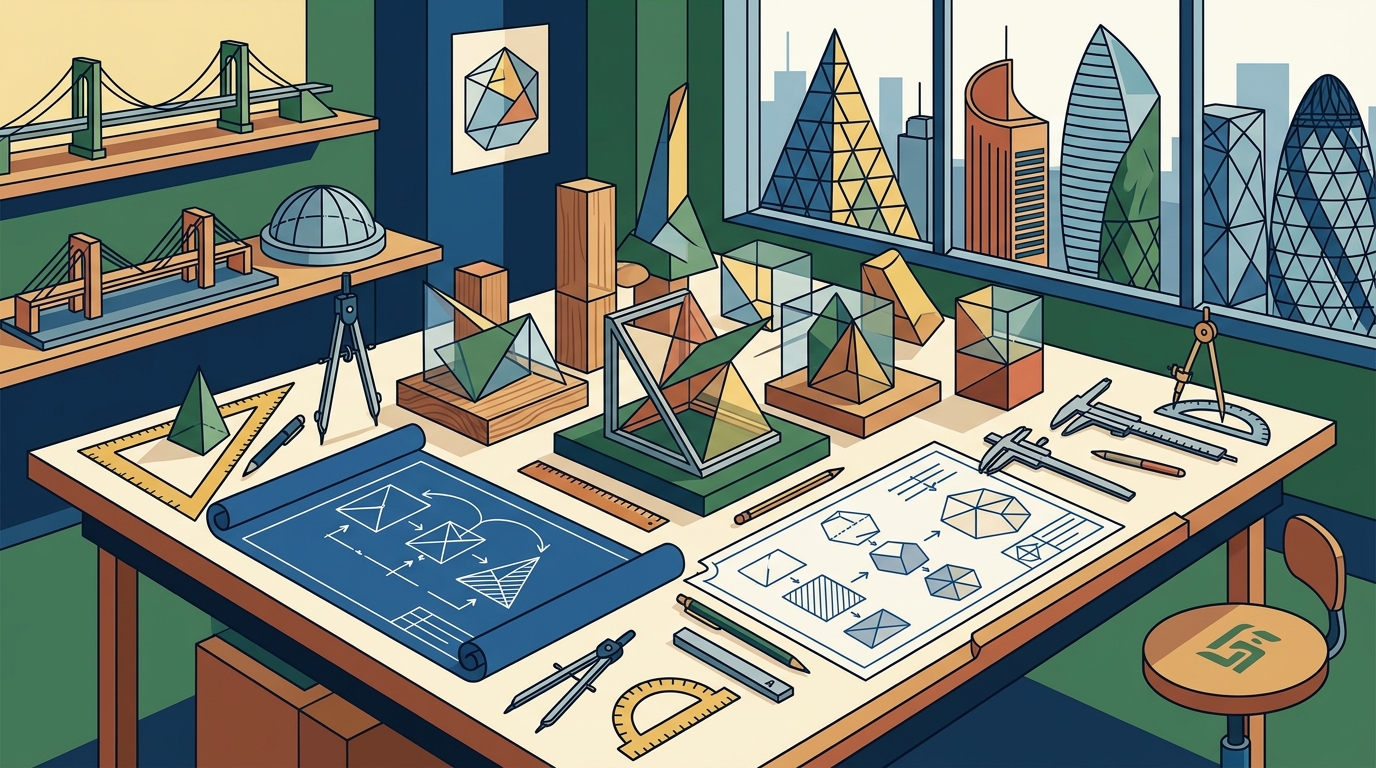
Comparing Instructional Methodologies
Not all approaches to teaching geometry are equally effective. Understanding the differences can help parents and students choose the right path. The table below compares traditional instruction with inquiry-based learning.
| Feature | Traditional Instruction | Inquiry-Based Learning |
|---|---|---|
| Focus | Procedural fluency and speed | Conceptual understanding and reasoning |
| Role of Teacher | Transmitter of knowledge | Facilitator of discovery |
| Role of Student | Passive recipient | Active explorer |
| Error Handling | Corrected immediately | Used as learning opportunities |
| Outcome | Ability to solve standard problems | Ability to tackle novel problems |
While traditional instruction may yield quick results on standardized tests, it often fails to build long-term retention. Students may forget formulas quickly if they do not understand their origins. Inquiry-based learning, on the other hand, builds a robust framework of understanding. This framework is more durable and adaptable. It allows students to apply their knowledge in new contexts. This is the goal of education: to create independent thinkers. To create students who can "do" math, not just "study" math.
Key Takeaways
- Mathematical Thinking: True mastery requires understanding the "why" behind the formulas, not just the "how."
- Spatial Reasoning: Exploration and manipulation of shapes are critical for developing the spatial skills needed for STEM success.
- Conjectures: Formulating educated guesses based on patterns is the bridge between observation and logical proof.
- Precision: Using precise language is essential for clear communication and deep understanding of geometric concepts.
- Proof: The process of proof provides absolute certainty and develops rigorous logical deduction skills.
- Growth Mindset: Believing that ability can be developed through effort is crucial for overcoming math anxiety.
- Expert Guidance: Working with an experienced tutor can accelerate the journey from confusion to clarity.
Frequently Asked Questions
What is the difference between a conjecture and a theorem?
A conjecture is an unproven statement based on observations or patterns. A theorem is a statement that has been rigorously proven to be true using logical deduction and established axioms.
How does inquiry-based learning help with math anxiety?
Inquiry-based learning reduces anxiety by shifting the focus from getting the "right answer" quickly to understanding the process. It validates mistakes as part of learning, which lowers the fear of failure.
Is geometry important for careers outside of mathematics?
Yes. Geometry develops spatial reasoning and logical thinking skills that are valuable in fields such as architecture, engineering, computer graphics, and even law and medicine.
What age is appropriate for learning geometric proofs?
Students typically begin formal proof in high school, around 9th or 10th grade. However, the foundations of logical reasoning can be introduced much earlier through exploration and pattern recognition.
How can parents support their child's geometry learning at home?
Parents can encourage exploration by discussing shapes in everyday life, playing geometry-based games, and asking open-ended questions about how things fit together.
Why is precise language important in geometry?
Precise language eliminates ambiguity. Terms like "congruent," "parallel," and "perpendicular" have specific meanings that are essential for clear communication and accurate problem-solving.
What is the role of technology in learning geometry?
Dynamic geometry software allows students to visualize and manipulate shapes in real-time, helping them discover properties and test conjectures more effectively than static diagrams.
Start Your Journey to Mastery
Building geometry mastery is a transformative process. It requires a shift in mindset, a willingness to explore, and the guidance of an expert. If you are ready to move beyond rote memorization and develop a deep, intuitive understanding of geometry, I invite you to connect. I offer private math tutoring services designed to meet students where they are. Whether you need support with basic concepts or advanced proofs, we can work together to build your confidence and competence. The first consultation is free. Let us discuss your goals and determine if we are a good fit. Visit the Contact Page to schedule your session. Together, we can turn "I hate math" into "I can do this!"