

From Memorization to Mastery: Essential Criteria for Geometry Understanding
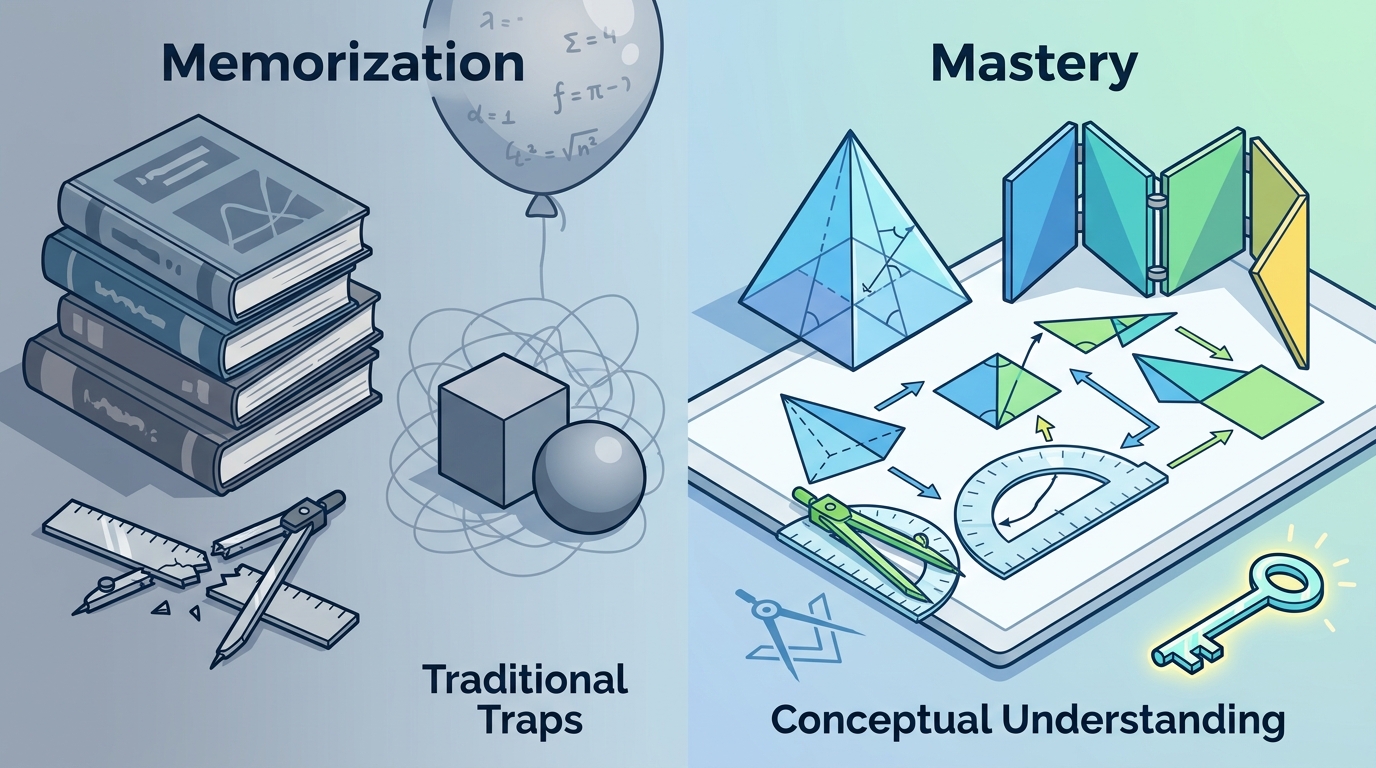
Traditional geometry education often traps students in a cycle of rote memorization, where formulas are recited without comprehension. Recent educational data indicates that over 60% of high school students struggle to apply geometric concepts beyond textbook exercises. This gap between procedural fluency and conceptual depth is the primary barrier to mathematical success. To bridge this divide, educators and parents must evaluate specific criteria that signal a shift from passive learning to active mathematical thinking.
Criterion 1: Prioritizing Mathematical Thinking Over Procedures
The first essential criterion for deep understanding is the explicit rejection of procedure-only instruction. True understanding comes from mathematical thinking, not just completing procedures. When students are taught to memorize the steps for finding the area of a triangle without understanding the relationship between the base, height, and the underlying shape, they fail when the problem format changes.
Effective tutoring must emphasize meaningful problem solving as the primary vehicle for learning. This means presenting students with non-routine problems that require them to construct their own solution paths. For example, instead of simply providing the formula for the volume of a pyramid, a master teacher guides students to derive it by comparing it to a prism of the same base and height. This approach ensures that students grasp underlying concepts and connect new ideas to what they already know.
According to the National Council of Teachers of Mathematics, students who engage in reasoning and sense-making are significantly more likely to retain mathematical knowledge long-term. This aligns with the belief that every student is capable of learning mathematics when given the opportunity to think deeply rather than just follow instructions.
Criterion 2: The Role of Metacognition and Error Tracking
Deep understanding requires students to become aware of their own thinking processes. Metacognition is the ability to think about your own thinking. In geometry, this often manifests as the ability to self-monitor and identify why a specific approach failed.
Many math "mistakes" are really mistakes of attention. A student might correctly apply the Pythagorean theorem but fail because they misidentified the hypotenuse. By teaching students how to track their errors and look for patterns, tutors help them understand why mistakes occur. This process transforms errors from signs of failure into essential data points for growth.
Learning to "pay attention to your attention" is a powerful skill that benefits students far beyond math. When students learn to pause and verify their assumptions before proceeding, they develop a toolbox of thinking skills and problem-solving strategies they can apply in new contexts. This is particularly critical in geometry, where visual-spatial reasoning and logical deduction must work in tandem.
Criterion 3: Building Cumulative and Cyclical Knowledge
Mathematical learning is both cumulative and cyclical. It builds like a tower, while also spiraling back to revisit and deepen earlier ideas. A common failure in geometry instruction is treating each unit as an isolated silo. Students learn congruence in Chapter 4 and similarity in Chapter 8 without seeing the structural similarities between the two topics.
Deep understanding emerges when tutors explicitly connect these topics. For instance, when introducing similarity, the tutor should revisit the proofs used for congruence, highlighting how the logic remains the same but the scale factor introduces a new variable. This cyclical approach reinforces earlier concepts while adding layers of complexity.
Research from the Journal for Research in Mathematics Education suggests that spiral curricula, where concepts are revisited at increasing levels of complexity, lead to stronger conceptual retention than linear, one-pass instruction. This method ensures that students do not forget foundational proofs when moving to more advanced trigonometry.
Criterion 4: Developing Precise Mathematical Language
Precise language deepens mathematical understanding. Geometry is a language of definitions, postulates, and theorems. When students use vague terms like "the same size" instead of "congruent," they lose the ability to communicate logical arguments effectively.
Effective tutoring must explicitly teach the nuances of mathematical terminology. For example, distinguishing between "parallel" and "perpendicular" is not just about vocabulary; it is about understanding the geometric relationships that define those terms. Students must learn to use precise definitions to justify their conclusions in proofs.
According to the Common Core State Standards for Mathematics, mathematical practice standard 6 emphasizes attending to precision. Students who can articulate their reasoning using correct terminology are better equipped to collaborate with peers and teachers, leading to a deeper collective understanding of the material.
Criterion 5: Fostering a Growth Mindset in Math
Perhaps the most critical criterion is the psychological state of the student. For students who believe they "will never get math," the journey from memorization to understanding begins with a shift in mindset. Making mistakes is not only acceptable, it is essential. Mistakes help the brain grow.
We now know that the brain is plastic, not static, and that ability and intelligence can develop with effort and practice. The idea that "neurons that fire together wire together" explains how new neural pathways are formed when students struggle productively and learn from errors. Real learning occurs at the point of challenge.
A fixed mindset leads students to avoid difficult problems to protect their self-image. A growth mindset encourages them to embrace difficulty as a necessary part of the learning process. Tutors play a vital role in this by celebrating the process of struggle rather than just the correct answer. This approach helps students move gradually from a fixed mindset toward a growth mindset.
Comparing Tutoring Approaches for Geometry
Not all geometry tutoring is created equal. The following table compares traditional rote-learning methods with the deep-understanding criteria outlined above.
| Feature | Traditional Rote Tutoring | Deep Understanding Tutoring |
|---|---|---|
| Primary Focus | Memorizing formulas and theorems | Deriving concepts and logical reasoning |
| Error Handling | Correcting mistakes immediately | Analyzing mistakes for pattern recognition |
| Language Use | Informal or inconsistent terminology | Precise mathematical vocabulary |
| Problem Solving | Applying known procedures to similar problems | Constructing novel solution paths |
| Mindset | Fixed (Math is innate ability) | Growth (Math is developed through effort) |
Key Takeaways
- Thinking Over Procedures: True understanding comes from mathematical thinking, not just completing procedures. Prioritize derivation over memorization.
- Metacognition: Teaching students to track errors and understand why mistakes occur is essential for long-term retention and problem-solving flexibility.
- Cyclical Learning: Mathematical learning is both cumulative and cyclical. Revisiting earlier concepts with new complexity reinforces neural pathways.
- Precise Language: Precise language deepens mathematical understanding. Students must use correct terminology to justify logical arguments.
- Growth Mindset: The brain is plastic, not static. Emphasizing effort over innate ability helps students overcome math anxiety.
- Master Teacher Impact: With 35+ years of classroom experience, expert guidance can turn "I hate math" into "I can do this!"
- Personalized Approach: Effective tutoring meets students where they are, addressing individual obstacles like organization, study habits, or confidence.
Frequently Asked Questions
How does deep understanding differ from rote memorization in geometry?
Rote memorization focuses on recalling formulas and theorems without context. Deep understanding involves deriving these concepts, understanding the underlying logic, and applying them to novel problems. This approach ensures students can adapt their knowledge to new situations.
What is the role of mistakes in learning geometry?
Mistakes are essential for brain growth. They provide data for students to analyze their thinking processes. By tracking errors and identifying patterns, students learn to self-monitor and improve their problem-solving strategies.
Can a student with math anxiety achieve deep understanding?
Yes. By fostering a growth mindset and emphasizing that the brain is plastic, tutors can help students overcome anxiety. The belief that every student is capable of learning mathematics is foundational to this process.
Why is precise language important in geometry?
Precise language deepens mathematical understanding. It allows students to communicate logical arguments clearly and avoid ambiguity. Using correct terminology is a key component of mathematical practice.
How often should geometry concepts be revisited?
Mathematical learning is cyclical. Concepts should be revisited regularly to deepen understanding and connect new ideas to prior knowledge. This spiral approach reinforces cumulative learning.
What is metacognition in the context of math tutoring?
Metacognition is the ability to think about your own thinking. In math, it involves self-monitoring, evaluating one's own problem-solving strategies, and adjusting approaches based on feedback.
Is online tutoring effective for developing deep understanding?
Yes, when conducted by a master teacher. Online tutoring can effectively replicate the interactive, dialogue-based approach needed for deep understanding, allowing for real-time feedback and personalized instruction.
Schedule Your Free Consultation
If you are ready to move beyond memorization and help your student achieve true mastery in geometry, it is time to take action. Michael J. Murphy, M.A., offers private math tutoring with a focus on deep conceptual understanding. With over 35 years of classroom experience, he has helped countless students transform their relationship with mathematics.
First consultations are free. This is an opportunity to find out if we are a good fit. Visit the Contact Page to schedule your session. For more information about the tutoring approach, review the Resume or explore the Home Page to learn more about the services offered.