

Traditional geometry education often traps students in a cycle of rote memorization, where formulas are recited without understanding. Recent educational data indicates that students who rely on procedural memory alone struggle significantly with spatial reasoning tasks in higher education. According to the National Council of Teachers of Mathematics, conceptual understanding is the primary predictor of long-term success in STEM fields. This guide outlines how to break that cycle using high-impact, low-cost strategies that prioritize deep learning over quick fixes. (Home)
Why Memorization Fails in Geometry
Geometry is not merely a collection of shapes and formulas. It is a logical system built on axioms and theorems. When students memorize the area of a triangle without understanding the relationship between base and height, they cannot apply that knowledge to irregular polygons. This gap in understanding leads to math anxiety, a condition that affects a significant percentage of high school students. Research shows that math anxiety correlates with lower working memory capacity, making complex problem-solving nearly impossible.
The cost of this failure is high. Students who do not develop spatial reasoning skills early on often drop out of engineering and architecture programs. According to the Bureau of Labor Statistics, STEM jobs are projected to grow much faster than average over the next decade. However, students who rely on memorization are ill-equipped for these rigorous demands. They lack the flexibility to adapt to novel problems. This is why shifting to conceptual mastery is not just an educational preference but a career necessity.
Core Concepts for Conceptual Mastery
To transition away from memorization, educators and tutors must focus on three foundational pillars. These pillars ensure that students build a robust mental model of geometric relationships. (Home)
1. Spatial Reasoning
Spatial reasoning is the ability to visualize and manipulate objects in space. It is the bedrock of geometric intuition. Students must learn to rotate shapes mentally, predict outcomes of transformations, and understand symmetry. Without this skill, geometry remains a two-dimensional exercise in paper-and-pencil calculations. Developing spatial reasoning allows students to "see" the solution before they write it down.
2. Logical Deduction
Logical deduction is the process of deriving conclusions from premises using strict rules of inference. In geometry, this means proving why a theorem is true rather than just accepting it as fact. When students engage in proof-writing, they learn to construct arguments. This skill transfers directly to computer science and law. It teaches them to question assumptions and verify results.
3. Mathematical Modeling
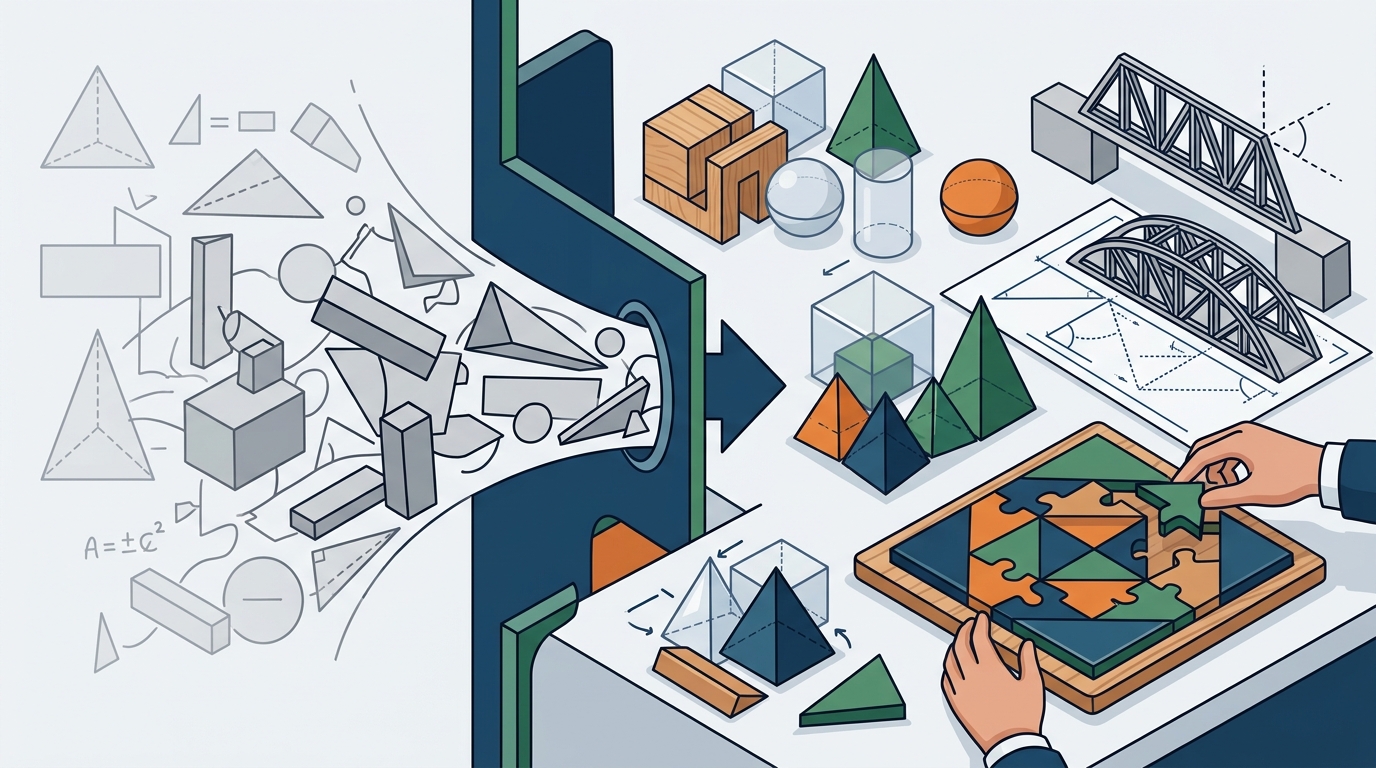
Mathematical modeling is the process of using mathematical structures to represent real-world phenomena. Geometry is everywhere, from architecture to computer graphics. By connecting geometric concepts to physical objects, students see the utility of their learning. This connection reduces the abstraction barrier and makes the subject matter tangible and relevant.
Cost-Effective Tools and Resources
Many believe that achieving conceptual mastery requires expensive software or specialized labs. This is a misconception. Several low-cost or free tools can dramatically enhance geometric understanding.
Dynamic Geometry Software
Tools like GeoGebra allow students to manipulate geometric figures dynamically. When a student drags a vertex of a triangle, the angles change, but the sum remains constant. This immediate visual feedback reinforces the theorem better than any static diagram. It turns abstract rules into observable laws. The software is free and accessible on most devices.
Physical Manipulatives
Physical manipulatives, such as pattern blocks or tangrams, provide tactile learning experiences. Students can physically fit shapes together to understand area and volume. This kinesthetic approach engages different parts of the brain. It is particularly effective for students who struggle with abstract visualization. The cost is minimal, often just a one-time purchase of basic blocks.
Open-Source Curricula
Open-source educational platforms provide rigorous, peer-reviewed geometry curricula at no cost. These resources often include interactive lessons and practice problems. They democratize access to high-quality education. Schools and tutors can adapt these materials to fit specific student needs without licensing fees.
Proven Teaching Methods
Implementing conceptual mastery requires a shift in teaching methodology. The following strategies are proven to work in both private tutoring and classroom settings.
The Concrete-Representational-Abstract (CRA) Sequence
The CRA sequence is a structured instructional approach. It begins with concrete objects, moves to representational drawings, and ends with abstract symbols. This scaffolding ensures that students build a solid foundation before tackling complex algebraic geometry. It prevents the common error of skipping steps in problem-solving. Each stage reinforces the previous one, creating a robust learning pathway.
Problem-Based Learning
Problem-based learning (PBL) places students in the role of investigators. Instead of being told the formula for the volume of a pyramid, they are given a challenge to find it. They might measure water displacement or use sand to fill models. This inquiry-based approach fosters curiosity and ownership of learning. Students retain information longer when they discover it themselves.
Metacognitive Reflection
Metacognition is the awareness and understanding of one's own thought processes. Encouraging students to reflect on how they solved a problem helps them identify their strengths and weaknesses. Asking "Why did you choose that method?" prompts deeper thinking. It moves the student from passive recipient to active analyst. This habit is essential for lifelong learning.
Strategy Comparison
Understanding the differences between traditional and conceptual approaches helps in making informed decisions. The table below summarizes the key distinctions.
| Feature | Memorization Approach | Conceptual Mastery Approach |
|---|---|---|
| Focus | Formula recall | Underlying principles |
| Student Role | Passive listener | Active investigator |
| Error Handling | Penalized | Learning opportunity |
| Long-term Retention | Low | High |
| Cost | Low (but high failure rate) | Low to Moderate (tools/resources) |
Key Takeaways
- Memorization leads to fragile knowledge that collapses under novel problem conditions.
- Spatial reasoning is a critical skill that can be developed through visualization exercises.
- Dynamic geometry software like GeoGebra provides free, high-impact visual feedback.
- The CRA sequence ensures a smooth transition from concrete to abstract thinking.
- Problem-based learning increases student engagement and retention of geometric concepts.
- Metacognitive reflection helps students become independent learners.
- Cost-effective strategies do not require expensive technology, just thoughtful pedagogy.
Frequently Asked Questions
How long does it take to shift from memorization to conceptual mastery?
The transition varies by student, but most learners see significant improvement in understanding within 8 to 12 weeks of consistent practice. The key is consistency and focusing on one concept at a time.
Is conceptual mastery more expensive than traditional tutoring?
No, it is often less expensive. By leveraging free digital tools and focusing on deep understanding, students may require fewer hours of tutoring to achieve mastery. Efficiency replaces volume.
Can self-study lead to geometric mastery?
Yes, with the right resources. Open-source curricula and dynamic geometry software allow self-learners to explore concepts independently. However, guided feedback from a mentor accelerates the process.
What is the role of proofs in conceptual mastery?
Proofs are essential. They force students to justify their reasoning and understand the logical structure of geometry. Without proofs, geometry remains a set of disconnected facts.
How do I know if my student is ready for proofs?
Readiness is indicated by a strong grasp of basic definitions and the ability to follow logical arguments. Start with simple two-column proofs and gradually increase complexity.
Does spatial reasoning training help with other subjects?
Absolutely. Spatial reasoning is linked to success in physics, chemistry, and even reading comprehension. It enhances overall cognitive flexibility.
What is the best age to start focusing on conceptual geometry?
Conceptual understanding should begin as early as middle school. However, it is never too late to shift approaches. High school students can still benefit greatly from this method.
Start Your Journey
Transitioning from memorization to mastery is a powerful investment in your academic future. It requires patience, but the rewards are substantial. If you are looking for personalized guidance to implement these strategies, professional tutoring can make all the difference. Michael J. Murphy, M.A., offers private math tutoring with a focus on conceptual understanding. With over 35 years of classroom experience, he helps students turn "I hate math" into "I can do this!". Visit the Contact Page to schedule a free consultation. Discover how Got Math Tutoring can help you achieve geometric mastery.