

Traditional math education often relies heavily on repetitive worksheet drills, yet research indicates that students who engage in verbal reasoning and visual modeling retain concepts significantly longer than those who only practice procedural memorization. According to the National Council of Teachers of Mathematics, conceptual understanding is the foundation of mathematical proficiency, requiring students to make connections between procedures and meanings. This article explores how to replace paper-heavy instruction with dynamic dialogue and tangible visualization techniques to build deep mathematical fluency.
Why Worksheets Fail to Build True Understanding
Worksheets are designed to test procedural fluency, not to build it. When a student encounters a problem they have not seen before, a worksheet offers no scaffolding. It provides no feedback loop and no opportunity for the learner to articulate their thought process. This leads to a phenomenon known as "procedural amnesia," where students forget how to solve problems shortly after the test because they never understood the underlying logic.
Mathematical learning is both cumulative and cyclical. It builds like a tower while also spiraling back to revisit and deepen earlier ideas. When instruction relies solely on written exercises, this spiral is broken. Students miss the opportunity to connect new ideas to what they already know. Without the ability to ask questions in real-time, confusion compounds. This is why many students who perform well on worksheets struggle in higher-level mathematics or real-world applications.
Furthermore, worksheets often induce math anxiety. The blank page represents a void that must be filled correctly, creating pressure rather than curiosity. In contrast, conversation and visual models lower the affective filter, allowing students to engage with the material without the fear of permanent failure. This approach aligns with the belief that every student is capable of learning mathematics when provided with the right tools and support.
The Conversation Framework for Math
Replacing worksheets with conversation requires a structured approach to dialogue. It is not enough to simply ask "Do you understand?" You must engage in metacognitive prompting, which forces the student to think about their own thinking. This method helps students develop a toolbox of thinking skills and problem-solving strategies they can apply in new contexts.
1. The "Why" and "How" Protocol
Instead of asking for an answer, ask for the process. When a student solves a problem, require them to explain their reasoning aloud. Use prompts such as "How did you decide to start here?" or "Why did you choose that operation?" This forces the student to retrieve the conceptual knowledge behind the procedure. If they cannot explain it, they do not truly understand it yet.
2. Error Analysis as a Learning Tool
Mistakes are essential for brain growth. The brain is plastic, not static, and ability develops with effort and practice. When a student makes an error, do not simply correct it. Instead, analyze the mistake together. Many math "mistakes" are really mistakes of attention. Teach students to track their errors and look for patterns. This helps them understand why mistakes occur and how to avoid them in the future.
3. Socratic Questioning
Guide the student to the answer through a series of logical questions. If they are stuck on a geometry problem, ask about the properties of the shapes involved. If they are struggling with algebra, ask about the balance of the equation. This method, known as Socratic questioning, helps students develop critical thinking skills that are essential for success in life. It shifts the dynamic from passive reception to active discovery.
Visual Models That Replace Paper
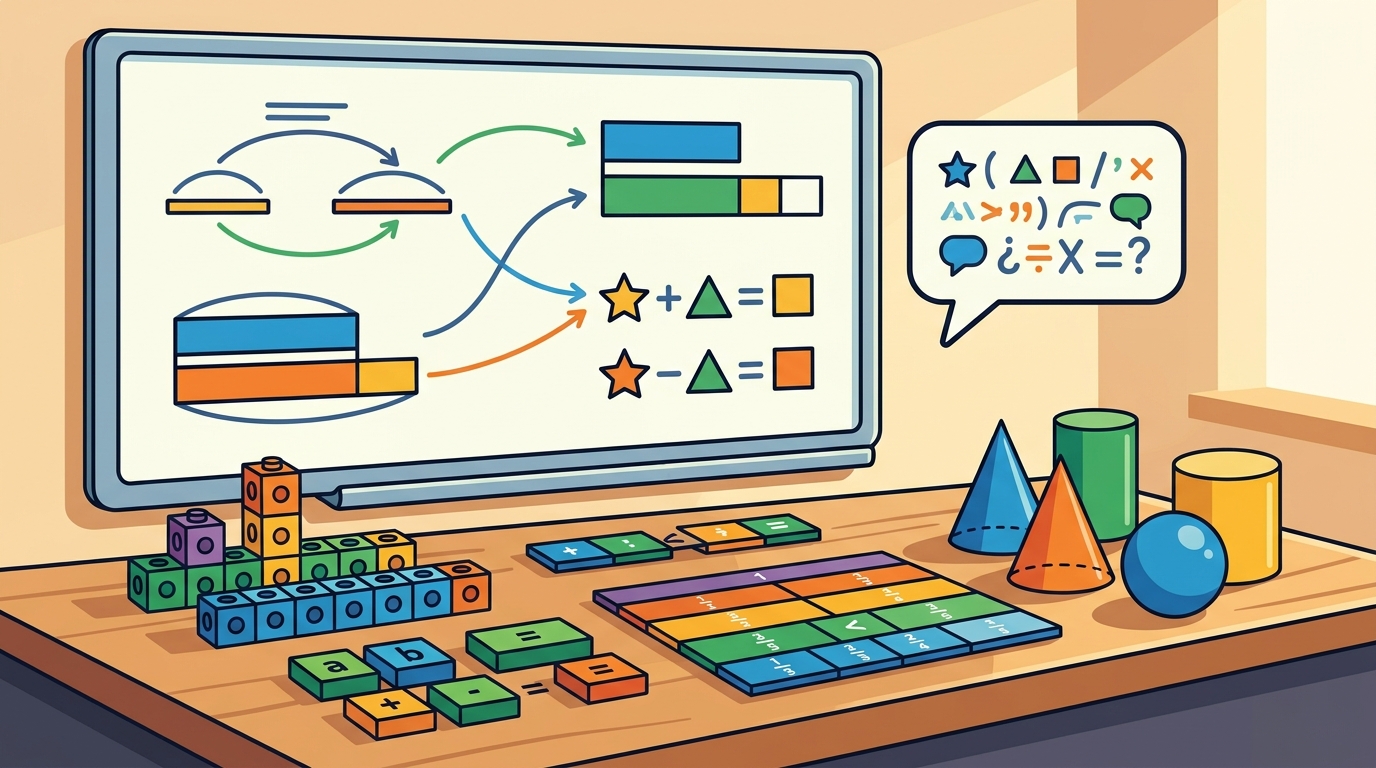
Visual models provide a concrete representation of abstract concepts. They allow students to "see" the math, making it easier to grasp underlying concepts. This is particularly effective for students who struggle with abstract notation or who have learning differences.
1. Bar Models and Tape Diagrams
Bar models are a powerful tool for solving word problems. They allow students to represent quantities and relationships visually. For example, in a problem involving ratios, students can draw bars to represent the parts and see the relationship between them. This visual representation makes the abstract concrete, allowing students to solve problems without relying on memorized formulas.
2. Number Lines and Number Talks
Number lines are essential for understanding number sense, operations, and fractions. They provide a spatial representation of numbers, helping students understand magnitude and distance. "Number talks" are short, daily discussions where students share their mental math strategies. This practice helps students see that there are multiple ways to solve a problem, fostering flexibility in thinking.
3. Manipulatives and Physical Models
For younger students or those struggling with abstract concepts, physical manipulatives such as blocks, counters, or geometric shapes are invaluable. They allow students to touch and move the math, creating a sensory connection to the concepts. This is particularly effective for teaching fractions, geometry, and algebraic concepts. The tactile experience reinforces the visual and verbal learning.
Implementation Guide for Parents and Tutors
Transitioning from worksheets to conversation and visual models requires a shift in mindset. It is not about abandoning practice, but about changing the medium of practice. Here is a step-by-step guide to implementing this approach.
Step 1: Assess the Current State
Begin by assessing the student's current level of understanding. Identify areas where they rely on rote memorization and areas where they have conceptual gaps. This will help you tailor your conversation and visual modeling strategies to their specific needs.
Step 2: Introduce Visual Models Gradually
Start by introducing one visual model at a time. For example, if you are working on fractions, introduce bar models first. Use them consistently until the student becomes comfortable with the representation. Then, gradually introduce more complex models as needed.
Step 3: Engage in Daily Math Conversations
Dedicate time each day to math conversations. This can be during a walk, a car ride, or at the dinner table. Discuss real-world math problems, such as calculating discounts, measuring ingredients, or estimating travel time. This helps students see the relevance of math in their daily lives.
Step 4: Encourage Error Analysis
When the student makes a mistake, use it as a learning opportunity. Ask them to explain their thinking and identify where the error occurred. Celebrate the mistake as a chance to grow. This helps students develop a growth mindset and reduces math anxiety.
Step 5: Monitor Progress and Adjust
Regularly assess the student's progress. Are they becoming more confident? Are they able to explain their reasoning? Are they able to apply concepts to new problems? Use this information to adjust your approach and ensure that the student is making steady progress.
Key Takeaways
- Conceptual Depth: Worksheets test procedure, but conversation builds understanding. Students who explain their reasoning retain concepts longer.
- Metacognition: Teaching students to "think about their thinking" is a powerful skill that benefits them far beyond math.
- Visual Scaffolding: Bar models, number lines, and manipulatives make abstract concepts concrete and accessible.
- Growth Mindset: Mistakes are essential for neural growth. Analyzing errors helps students understand their thought processes.
- Real-World Application: Connecting math to daily life increases engagement and relevance.
- Personalized Support: One-on-one tutoring allows for tailored visual and conversational strategies that classroom instruction cannot provide.
- Long-Term Success: Students who develop strong conceptual foundations are better prepared for advanced mathematics and STEM careers.
Frequently Asked Questions
How do I know if my child is ready to move away from worksheets?
If your child can solve problems correctly but cannot explain how they did it, they are likely relying on rote memorization. This is a strong indicator that they need more conceptual work through conversation and visual models.
Can visual models be used for advanced math topics?
Yes. Visual models are not just for elementary math. Graphs, coordinate planes, and geometric proofs are all visual models used in advanced mathematics. They help students visualize complex relationships and functions.
How much time should I spend on math conversations?
Even 10-15 minutes of focused math conversation daily can be highly effective. The key is consistency and quality, not duration. Engage in meaningful dialogue rather than superficial questioning.
What if my child is resistant to talking about math?
Start with low-stakes, real-world problems. Avoid asking "school-like" questions initially. Use games, puzzles, or everyday scenarios to make the conversation feel natural and less pressured.
Are manipulatives only for young children?
No. While manipulatives are crucial for early math, physical and visual models are used in higher education. For example, vector diagrams in physics or geometric models in calculus help students visualize abstract concepts.
How does this approach help with math anxiety?
Math anxiety often stems from the fear of being wrong. Conversation and visual models create a safe space for exploration. Mistakes are analyzed and learned from, rather than punished, which reduces fear and builds confidence.
Can I use this approach for standardized test prep?
Absolutely. Understanding the "why" behind a problem helps students solve unfamiliar problems on tests. It builds the flexibility and critical thinking skills needed for success on standardized assessments.
Book Your Free Consultation
Transitioning from worksheets to a conversation-based, visual model approach requires expertise and guidance. Michael J. Murphy, M.A., offers private math tutoring in the Akron, Ohio area, combining 35+ years of classroom experience with a deep understanding of mathematical pedagogy. His approach focuses on turning "I hate math" into "I can do this!" by building true understanding rather than just procedural fluency.
Whether you are looking for in-person or online tutoring, the first step is a free consultation to determine if we are a good fit. Visit the Contact Page to schedule your session. Explore the Resume to learn more about the methodology and experience behind the instruction. For more insights on teaching strategies, visit the Got Math Home page.