

Effective Math Education Techniques for Students with a Fixed Mindset
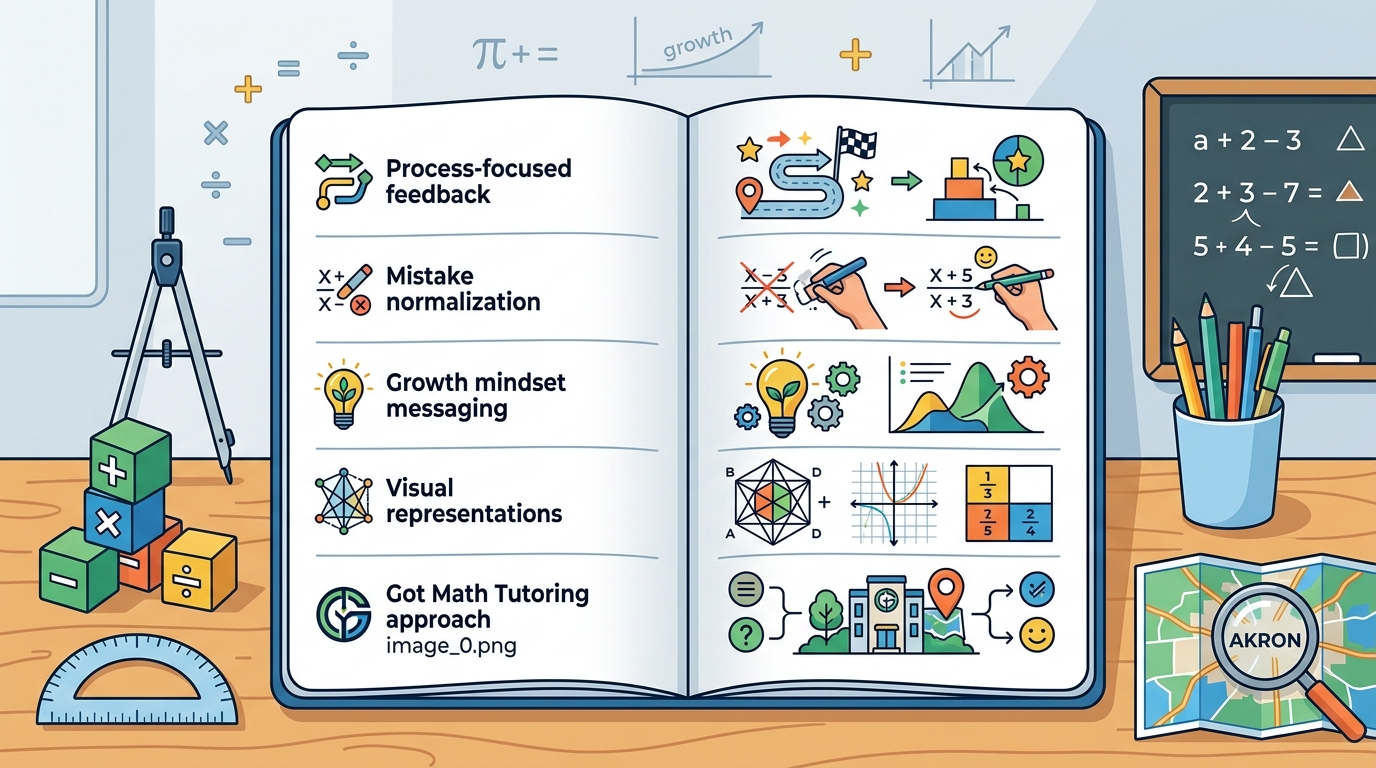
Effective math education techniques for students with a fixed mindset involve shifting focus from innate ability to effort and strategy. This guide covers process-focused feedback, mistake normalization, growth mindset messaging, and visual representations. It explains how Got Math Tutoring applies these methods to help students in Akron, Ohio, build confidence and master mathematical concepts through personalized instruction.
Process Focused Feedback
Process-focused feedback is a teaching strategy that evaluates the steps a student takes to solve a problem rather than just the final answer. Traditional grading often rewards only the correct result, which reinforces the idea that math is a talent you either have or lack. When a student receives a wrong answer, they may conclude they are simply not smart enough. By praising the logical sequence, the use of formulas, or the effort in checking work, educators can decouple self-worth from immediate success. For additional details, review the Contact.
Shifting the Narrative from Talent to Effort
Students with a fixed mindset believe intelligence is static. They view difficult problems as threats to their identity. A tutor who highlights the process helps reframe difficulty as a challenge to be overcome through work. For example, if a student struggles with algebraic manipulation, the instructor can point out that the setup was correct and the error occurred in a specific calculation step. This specific feedback shows that the student understands the core concept and only needs to refine their execution. For additional details, review the .
Implementing Specific Praise
Vague praise like "good job" is less effective than specific commentary on the method. Instructors should describe exactly what the student did well. Did they use a diagram? Did they check their units? Did they break a complex problem into smaller parts? This type of feedback builds a mental model of what good mathematical thinking looks like. It encourages students to replicate these strategies in future problems, fostering independence and resilience.
Mistake Normalization
Mistake normalization is the practice of treating errors as essential components of the learning process rather than failures. In many classrooms, mistakes are penalized, creating an environment where students hide their confusion to avoid judgment. This fear prevents them from asking questions or attempting challenging problems. By normalizing errors, educators create a safe space where students feel comfortable experimenting and taking intellectual risks.
The Role of Errors in Learning
Research in cognitive science suggests that making mistakes strengthens neural pathways associated with learning. When a student encounters an error, their brain engages in a process of error detection and correction. This active engagement leads to deeper retention than simply being told the correct answer. Instructors can leverage this by analyzing mistakes together. Instead of just correcting the error, they can ask the student to identify where the logic broke down. This turns a negative experience into a diagnostic tool.
Creating a Safe Learning Environment
For students who believe they are bad at math, the fear of making mistakes is paralyzing. A supportive tutor helps lower this anxiety. When a student makes an error, the instructor responds with curiosity rather than criticism. Phrases like "let's see what happened there" or "that's an interesting approach, what did you try?" signal that the process matters more than the outcome. This psychological safety allows students to engage more deeply with the material, knowing that they will not be judged for their initial attempts.
Growth Mindset Messaging
Growth mindset messaging is the use of language that emphasizes the malleability of intelligence and the value of effort. Carol Dweck, a psychologist at Stanford University, popularized the concept of growth versus fixed mindsets. A fixed mindset assumes abilities are fixed traits, while a growth mindset believes abilities can be developed through dedication and hard work. In math education, this distinction is critical because many students believe they are simply "not math people."
Language and Its Impact
The words educators use shape how students perceive their own capabilities. Avoiding labels like "smart" or "gifted" in favor of terms like "persistent" or "strategic" helps students focus on their actions rather than their traits. When a student solves a difficult problem, praising their persistence reinforces the idea that effort leads to success. This type of messaging helps students internalize the belief that their mathematical ability can grow over time. It shifts their focus from proving their intelligence to developing it.
Challenging Fixed Mindset Beliefs
Students often hold deep-seated beliefs about their mathematical abilities. These beliefs can stem from past experiences of failure or negative feedback. A tutor can help challenge these beliefs by providing evidence of growth. Keeping a record of past struggles and current successes can be powerful. When a student sees that they have improved in areas they once found impossible, it provides concrete proof that their abilities are not fixed. This evidence-based approach helps dismantle the fixed mindset and replaces it with a growth-oriented perspective.
Visual Representations
Visual representations are tools that translate abstract mathematical concepts into concrete images or diagrams. Many students with a fixed mindset struggle with math because they find it abstract and disconnected from reality. Visual aids help bridge this gap by providing a tangible way to understand complex ideas. They allow students to see the structure of a problem, making it easier to identify patterns and relationships.
Connecting Abstract Concepts to Concrete Images
For example, when teaching fractions, using pie charts or number lines helps students visualize the concept of parts of a whole. When teaching algebra, using balance scales can illustrate the principle of equality. These visual tools make abstract symbols more meaningful. They help students build intuition, which is essential for problem-solving. By seeing the math, students can develop a deeper understanding of why certain operations work, rather than just memorizing rules.
Enhancing Comprehension and Retention
Visual representations can also aid in memory retention. When information is presented in multiple formats, such as text, symbols, and images, it is encoded in different parts of the brain. This multi-modal approach strengthens memory traces, making it easier for students to recall information later. Instructors can use visual aids to reinforce key concepts and help students create mental models that they can apply to new problems. This approach supports long-term learning and helps students become more confident and independent problem-solvers.
Comparison of Techniques
| Technique | Primary Goal | Key Strategy | Impact on Fixed Mindset |
|---|---|---|---|
| Process Focused Feedback | Value effort and strategy | Praise specific steps, not just results | Decouples self-worth from immediate success |
| Mistake Normalization | Reduce fear of error | Treat errors as learning opportunities | Creates psychological safety for experimentation |
| Growth Mindset Messaging | Believe in malleable ability | Use language emphasizing effort and growth | Challenges belief in static intelligence |
| Visual Representations | Make abstract concepts concrete | Use diagrams and models | Builds intuition and reduces abstraction anxiety |
Key Takeaways
- Process-focused feedback evaluates the steps taken to solve a problem, not just the final answer.
- Mistake normalization treats errors as essential components of learning, reducing fear and encouraging experimentation.
- Growth mindset messaging uses language that emphasizes the malleability of intelligence and the value of effort.
- Visual representations translate abstract mathematical concepts into concrete images, aiding comprehension and retention.
- Specific praise on strategy and effort helps students decouple self-worth from immediate success.
- Creating a safe learning environment allows students to engage more deeply with challenging material.
- Challenging fixed mindset beliefs with evidence of growth helps students internalize the belief that their abilities can develop.
Frequently Asked Questions
What is a fixed mindset in math?
A fixed mindset in math is the belief that mathematical ability is a static trait that cannot be changed. Students with this mindset often avoid challenging problems and give up easily when they encounter difficulties.
How can process-focused feedback help students with a fixed mindset?
Process-focused feedback helps by praising the steps and strategies used to solve a problem, rather than just the final answer. This shifts the focus from innate ability to effort and strategy, reinforcing the idea that mathematical skill can be developed.
Why is mistake normalization important in math education?
Mistake normalization is important because it reduces the fear of error, which is a major barrier for students with a fixed mindset. By treating mistakes as learning opportunities, educators create a safe environment where students feel comfortable experimenting and taking intellectual risks.
What is growth mindset messaging?
Growth mindset messaging is the use of language that emphasizes the malleability of intelligence and the value of effort. It helps students believe that their abilities can be developed through dedication and hard work, rather than being fixed traits.
How do visual representations aid in math learning?
Visual representations aid in math learning by translating abstract concepts into concrete images. This helps students build intuition and understand the structure of problems, making it easier to identify patterns and relationships.
Can these techniques be applied to all students?
Yes, these techniques can be applied to all students, but they are particularly beneficial for those with a fixed mindset. They help create a supportive learning environment that encourages effort, resilience, and a positive attitude toward mathematics.
How can parents support a growth mindset at home?
Parents can support a growth mindset at home by praising effort and strategy, normalizing mistakes, and using language that emphasizes growth. They can also encourage their children to view challenges as opportunities to learn and grow.
Conclusion
Helping students with a fixed mindset succeed in math requires a shift in how we teach and communicate. By using process-focused feedback, normalizing mistakes, employing growth mindset messaging, and utilizing visual representations, educators can create an environment where students feel confident and capable. Got Math Tutoring in Akron, Ohio, specializes in these personalized approaches, helping students turn "I hate math" into "I can do this." If you are looking for a tutor who understands the importance of mindset in mathematical success, consider scheduling a consultation with our team.