

Research consistently shows that personalized instruction yields significantly higher academic gains than traditional classroom settings. According to a comprehensive meta-analysis by John Hattie, the effect size of direct personal guidance is nearly double that of large-group instruction. This data highlights why families are increasingly seeking specialized support for students who struggle with mathematical concepts. Understanding the specific advantages of each model helps parents make informed decisions about their child's educational journey.
Core Differences in Learning Dynamics
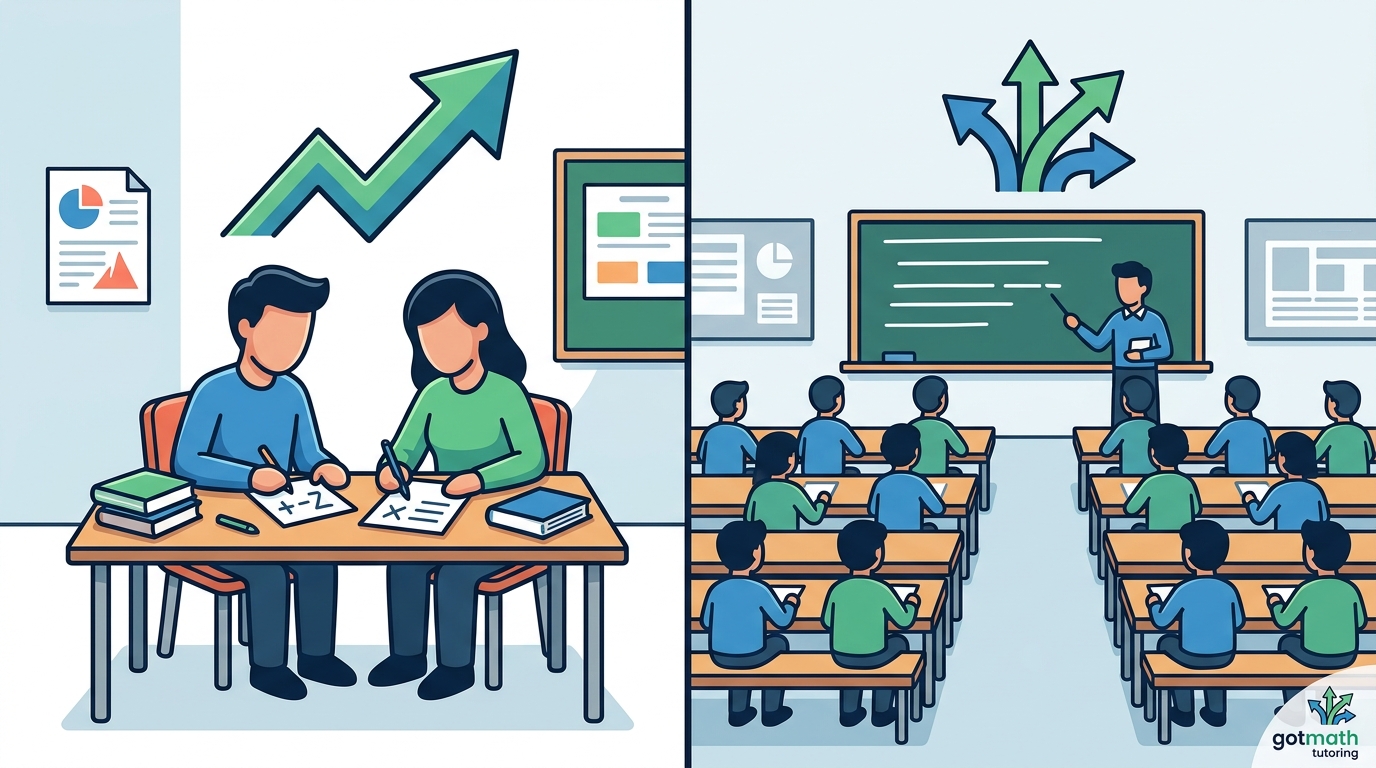
The fundamental difference between one-on-one tutoring and group classes lies in the pacing and adaptability of the instruction. In a group setting, the teacher must adhere to a standardized curriculum designed for the average student. This approach often leaves advanced students bored and struggling students behind. Conversely, private tutoring operates on a demand-driven model. The instructor adjusts the pace in real time based on the student's immediate comprehension levels.
Mathematics is a cumulative subject. If a student misses a foundational concept in algebra, they will likely fail to grasp calculus later. One-on-one sessions allow for immediate remediation of these gaps. Group classes often move forward regardless of individual understanding, creating a compounding deficit over time.
The Power of Personalized Attention
Private tutoring offers a level of diagnostic precision that is impossible in a classroom of twenty or more students. A dedicated tutor can identify specific cognitive patterns, such as whether a student struggles with arithmetic operations or conceptual visualization. This targeted approach accelerates learning because the instruction is tailored to the individual's unique cognitive profile.
Michael J. Murphy, a master teacher with over 35 years of experience, emphasizes that true understanding comes from mathematical thinking rather than rote procedure completion. In a private setting, the tutor can guide the student through the "why" behind each formula. This method builds a robust mental framework. Students learn to ask better questions and develop critical thinking skills that extend beyond the math classroom.
Furthermore, private tutoring allows for the integration of metacognitive strategies. Tutors teach students how to monitor their own attention and recognize patterns in their errors. This self-regulation skill is crucial for long-term academic success. It transforms the student from a passive recipient of information into an active problem solver.
Navigating Group Class Dynamics
Group math classes offer distinct benefits that private tutoring cannot replicate. The primary advantage is the development of social learning skills. Students in group settings learn to articulate their reasoning to peers, listen to alternative problem-solving methods, and collaborate on complex tasks. This environment mirrors real-world professional settings where teamwork is essential.
Additionally, group classes provide a sense of community. Students often feel less isolated when they realize their peers are facing similar challenges. This shared experience can reduce math anxiety and foster a supportive learning culture. Peer-to-peer teaching is also a powerful tool. Explaining a concept to a classmate reinforces the explainer's understanding while helping the listener.
However, the effectiveness of group classes depends heavily on the student's baseline confidence. Students with severe math anxiety may feel overwhelmed or embarrassed to ask questions in front of others. In these cases, the social pressure can hinder learning rather than help it. The teacher's ability to manage diverse needs in a large group is also a limiting factor.
Cost and Accessibility Analysis
Financial considerations play a significant role in the decision-making process for many families. Group classes are generally more cost-effective per hour of instruction. The cost is distributed among multiple students, making it a viable option for ongoing support. Private tutoring, by contrast, commands a premium rate due to the intensity and customization of the service.
For example, private tutoring rates can range from $100 to $150 per hour depending on the tutor's expertise and location. While this seems expensive, the return on investment can be higher if the tutoring leads to significant grade improvements or college readiness. Some tutors offer sliding scales based on need and commitment, making high-quality instruction more accessible.
Accessibility also extends beyond cost. Group classes require physical presence at a specific time, which can be challenging for busy schedules. Online group classes offer flexibility but may lack the personal engagement of in-person sessions. Private tutoring can be conducted online or in-person, offering maximum flexibility for families in the Akron, Ohio area and beyond.
Psychological Impact and Confidence
Math anxiety is a real obstacle for many students. It is not merely a lack of skill but a psychological response to perceived failure. One-on-one tutoring is particularly effective in addressing this issue. The safe, non-judgmental environment allows students to make mistakes without fear of ridicule. This safety net is crucial for rebuilding confidence.
When students feel safe to struggle, they are more likely to engage in productive failure. This process is essential for neural growth. The brain forms new pathways when it confronts challenges. A private tutor can scaffold these challenges, ensuring the student is always operating at the edge of their ability without being overwhelmed.
Group classes can sometimes exacerbate anxiety if the student feels they are falling behind their peers. The competitive nature of some group environments can be detrimental to students who need a slower, more supportive pace. However, for students who thrive on peer interaction, group classes can boost confidence through social validation and shared achievement.
Comparative Summary
| Feature | One-on-One Tutoring | Group Math Classes |
|---|---|---|
| Pacing | Customized to student speed | Standardized for the group |
| Feedback | Immediate and specific | Delayed or general |
| Cost | Higher hourly rate | Lower cost per hour |
| Social Interaction | Minimal | High peer engagement |
| Best For | Remediation and acceleration | Practice and collaboration |
Key Takeaways
- Personalized instruction has a significantly higher effect size on academic outcomes than group instruction.
- Private tutoring allows for real-time adaptation to the student's learning pace and style.
- Group classes offer valuable social learning opportunities and peer-to-peer teaching benefits.
- Math anxiety is often reduced in one-on-one settings due to the safe, non-judgmental environment.
- Cost-effectiveness favors group classes, but private tutoring may offer a higher return on investment.
- Master teachers like Michael J. Murphy emphasize mathematical thinking over rote procedure completion.
- Sliding scale pricing may be available for private tutoring to accommodate different financial needs.
Frequently Asked Questions
Is private tutoring worth the cost?
Private tutoring is worth the cost when a student needs targeted remediation or acceleration that a group class cannot provide. The personalized attention often leads to faster grade improvements and greater confidence.
Can group classes help with math anxiety?
For some students, group classes help by showing them they are not alone. However, for others, the social pressure can worsen anxiety. One-on-one tutoring is generally safer for severe anxiety.
What is the difference between a tutor and a teacher?
A teacher manages a group curriculum, while a tutor focuses exclusively on the individual student's needs. Tutors often have more flexibility to adapt their methods to the student's cognitive style.
How do I know if my child needs private tutoring?
If your child is consistently struggling despite effort, or if they are bored in class, private tutoring may be beneficial. A free consultation can help determine the best fit.
Are online tutoring sessions effective?
Yes, online tutoring can be highly effective, especially when using interactive tools. It offers flexibility and access to expert tutors regardless of location.
What subjects do tutors typically cover?
Tutors cover a wide range of subjects, from basic arithmetic to advanced calculus. The specific subjects depend on the tutor's expertise and the student's needs.
How long does tutoring usually last?
The duration varies based on the student's goals. Some students need short-term support for a specific test, while others benefit from ongoing guidance throughout the school year.
Can tutoring help with standardized tests?
Yes, tutoring can significantly improve performance on standardized tests by teaching test-taking strategies and reinforcing key concepts.
Next Steps
If you are considering private math tutoring, it is essential to find a tutor who aligns with your child's learning style. Michael J. Murphy offers a free first consultation to determine if his approach is a good fit. Visit the Contact Page to schedule a session. Learn more about the teaching methodology and background. Explore the Got Math Tutoring homepage for additional resources.